The snow started around four that afternoon, fine and unhurried, the kind that makes a mountain town look like it was built for a postcard rather than actually lived in. By the time I turned off the highway toward Evergreen, it had thickened into something heavier, catching in the headlights and dissolving against the windshield before the wipers could clear it away. I drove with both hands on the wheel and my shoulders up near my ears, the particular posture I always seemed to fall into on this drive, as if my body remembered every version of this trip before my mind caught up.
In the back seat, Lily hummed along to a song only she could hear, her boots kicking gently against the seat in front of her. She had insisted on wearing her red tights that morning, the ones with tiny white snowflakes stitched into the pattern, paired with a green dress she’d picked out herself because, she informed me with great seriousness, Christmas colors mattered. On her lap she held a piece of paper folded in careful quarters, the edges already going soft from how many times she had checked to make sure it was still there.
“Do you think Grandpa will like it?” she asked for the third time since we’d left Lakewood.
“He’s going to love it,” I said, and I meant it the way you mean things you’ve decided to believe rather than things you actually know.
I glanced at her in the rearview mirror. Seven years old and still young enough to think a drawing could fix anything, still young enough to believe that love worked the way she’d been taught it worked in picture books, where you gave someone your heart on a piece of paper and they folded you into their arms because of it. I had been that age once too, sitting in the back seat of my own mother’s car, believing the same things about my father. It had taken me the better part of three decades to stop believing them, and even now, driving up this mountain with my daughter’s careful drawing riding in her lap, some stubborn part of me was still hoping.
The house came into view the way it always did, sudden and glowing, perched on its half acre like something staged for a magazine spread. My parents had bought it eleven years ago, after my father’s business had finally tipped from comfortable into genuinely wealthy, and they had spent every Christmas since making sure everyone who walked through the door understood what that meant. Icicle lights traced the roofline. A wreath the size of a car tire hung on the door. Through the tall windows I could see the tree, real and enormous, glittering gold, and beneath it what looked like an entire toy store’s worth of wrapped boxes.

I parked at the end of the driveway, behind my brother’s car and my sister’s minivan, and sat there for a moment with the engine ticking as it cooled.
“We’re here,” I told Lily, mostly to convince myself.
She was already unbuckling her seatbelt, drawing clutched to her chest, practically vibrating with the specific joy that only children seem able to access at Christmas, the joy that hasn’t yet been complicated by memory.
We walked up together, her small mittened hand in mine, snow settling on her dark curls before we even reached the porch light. My mother opened the door before I could knock, dressed in the deep red sweater she wore every year for this exact purpose, her smile already arranged into its holiday setting.
“You made it,” she said. “Traffic out of Lakewood must have been dreadful in this weather.”
“It was fine,” I said.
Lily beamed up at her. “Hi, Grandma. Merry Christmas.”
My mother’s eyes flicked down to her, and for a fraction of a second, so brief that if you weren’t watching for it you’d have missed it entirely, something in her face went carefully blank. Then the smile reassembled itself, and she said, “Well, come in, come in, you’re letting the cold in,” and turned back into the house before Lily’s greeting had fully landed.
I had learned, over the years, to catalogue these small moments rather than react to them. It was easier that way. React to every flicker of coldness and you spend your whole life at war. Catalogue them instead, file them away, and you can walk through the door and keep smiling, even while some quiet accountant in the back of your mind keeps a running tally that never quite balances.
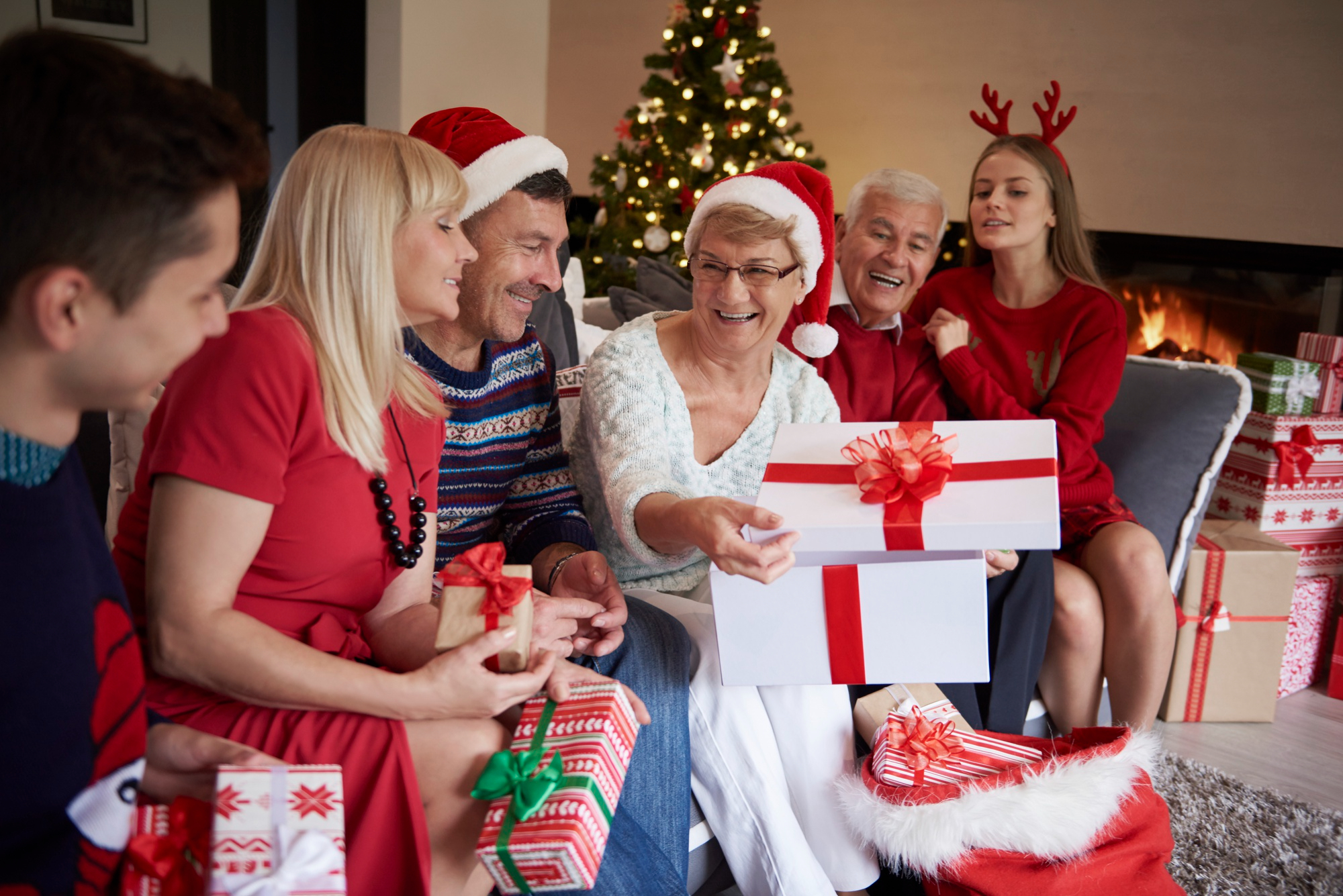
Inside, the party was in full swing. My aunt was refilling a tray of deviled eggs in the kitchen. My uncle had commandeered the armchair nearest the fire and was holding court about a hunting trip. Cousins ran in loose formation between the furniture, shrieking with the specific abandon of children who’ve been allowed too much sugar too early in the evening. Someone had a Bing Crosby record playing low beneath all of it, and the whole house smelled like cinnamon and roasted ham and the particular mustiness of a fire that had been burning since noon.
My father stood near the tree, exactly where he always stood, a mug of something in one hand and a garbage bag sized sack of presents in the other. He had a way of positioning himself at these gatherings that made it look accidental, like he’d simply wandered near the tree and happened to end up at the center of everyone’s attention, when in reality he had built his entire adult life around exactly this kind of staging. He liked being the one who gave things out. He liked the moment right before a child tore into wrapping paper, the anticipation on their face turned toward him like a small sun.
“Alright, everybody gather round,” he boomed, and the children obeyed instantly, forming a loose, excited semicircle at his feet.
Lily let go of my hand and drifted toward the group, drawing still pressed to her chest, finding a spot near the back where she could see. I stayed near the doorway, close enough to watch, far enough to not be part of the performance. My brother caught my eye from across the room and gave me a small, tired smile, the kind we’d been trading with each other at these gatherings since we were teenagers, a silent language that meant something like I see it too and there’s nothing we can do about it tonight.
My father began pulling gifts from the bag one at a time, calling out names with theatrical flourish. A remote control car for Jack. A dollhouse for Harper. An elaborate science kit for one of my cousin’s boys, still in its plastic wrap, clearly expensive. Every gift was wrapped with the same care, foil paper and curled ribbon, name tags written in his own careful hand. The children squealed and tore into paper and held their new treasures up for inspection, and my father beamed at each of them like a king surveying a kingdom he’d built entirely out of goodwill.
I lost count somewhere in the thirties. Lily didn’t. I could see her lips moving slightly as she watched each gift emerge and disappear into someone else’s hands, and I recognized the exact moment her small, hopeful smile began to falter, not collapsing all at once but eroding slowly, gift by gift, the way sandcastles go when the tide comes in steady instead of sudden.
She started drifting backward, toward me, one careful step at a time, until she was close enough that I could put a hand on her shoulder. She looked up at me, and I gave her what I hoped was a reassuring smile, though I could feel something cold starting to gather in my own chest, a premonition I didn’t want to name yet.
The bag was nearly empty. My father reached in and pulled out one last box, small and wrapped in silver paper, and the room did that thing rooms do around a final gift, everyone leaning in slightly, the air going soft with anticipation.
Lily’s fingers found mine and squeezed.
My father looked around the semicircle of children, and then his eyes landed on her, standing just behind the group with her hand-drawn picture still held against her chest like a shield.
“This one isn’t for you,” he said.
I remember thinking, in that first half second, that it was a joke. That he’d pull a second box from somewhere, or laugh and say he was only teasing, or do any of the small cruel things fathers sometimes do to children in the name of a bit that always lands funnier in their own head than in reality. I waited for the punchline.
It didn’t come.
He just kept looking at her, his expression settled into that particular calm he wore when he wanted a room to understand something without him having to say it outright.
“Only certain children are on the list tonight,” he said.
The temperature of the room changed. I felt it before I understood it, the way you feel a storm coming before the sky actually darkens. Conversations that had been humming along in the background went quiet. My aunt, halfway through refilling someone’s glass, paused with the bottle tilted midair. Somewhere near the kitchen, I heard someone whisper, low and horrified, oh no.
Lily went very still.
Not dramatic. Not loud. She didn’t cry out or ask why or do any of the things a child might reasonably do when publicly excluded from something in front of a room full of relatives. She just went quiet and small, her face working through some private arithmetic, trying to understand what she had done wrong, why the rules that applied to every other child in that room suddenly didn’t apply to her. Her mouth pressed into a thin, determined line, the specific look of a child trying very hard to be brave, and then, despite every effort, her eyes filled and a tear slipped free and traced a slow line down her cheek.
No one said anything.
My mother stood near the dining room doorway, arms folded, watching the scene with an expression I can only describe as weather tolerant, the look of someone observing a passing shower rather than a child’s heart quietly breaking in the middle of a living room.
I knelt down in front of Lily and put both hands on her shoulders, blocking her view of the tree, of the pile of gifts that would never include her, of the grandfather who had just decided, in front of an audience, that she did not belong to this family the way the other children did.
“We’re leaving, sweetheart,” I said, keeping my voice low and even.
She nodded, once, the kind of nod children give when they’re trying very hard to seem older than they are, to absorb a hurt without making anyone else uncomfortable with it. It was the bravest thing I had ever watched her do, and it broke something in me more thoroughly than any amount of shouting would have.
I stood up. I looked at my father, and for a moment I let myself really see him, not as the man who had raised me but as a stranger might see him, silver haired and self satisfied, standing next to a tree buried in gifts he’d bought to prove something to people who would forget the gesture by New Year’s, having just told a seven year old girl she wasn’t worth including.
“Alright then,” I said. “Goodbye.”
I didn’t raise my voice. I didn’t ask him to explain himself, didn’t demand an apology, didn’t give the room the kind of scene it was clearly braced for. I think that was what unsettled him most, more than shouting ever could have. He had built his whole life around control, around being the loudest and most immovable presence in any room, and my quiet made him smaller than any argument would have.
I took Lily’s hand and walked her out through the front hall, past the coat rack loaded with everyone else’s expensive jackets, past the mirror that had reflected forty years of my family’s version of togetherness, and out into the snow.
The cold outside felt almost merciful after the heat of that room. Lily pressed her face into my coat and began to cry in earnest now, the kind of crying that had been held back too long and came out all at once, her small shoulders shaking under my hands. I crouched on the porch and held her, snow gathering in her hair, and looked out at the long white driveway curving down toward the road, and let her cry as long as she needed to.
I should have simply put her in the car and driven home. That would have been the reasonable thing, the thing a calmer version of myself might have done. Instead, standing there with my daughter shaking against my chest, something else rose up in me, quiet and fully formed, the way certain decisions arrive already made, as if some part of you decided them long before the rest of you caught up.
For three years I had built a company out of almost nothing. I had done site estimates from the front seat of my truck between school pickups, signed payroll at midnight with Lily asleep on the office couch, turned a design and construction business into something that now employed forty people and moved millions of dollars a year through projects across the Front Range. My parents had never quite believed I would make anything of it. My father used to call it my little hobby, back when it was three employees and a rented office above a dry cleaner. He’d stopped calling it that once the numbers got too large to dismiss, but he’d never once said he was proud of me. Not once.
And sitting in my office in Denver, in a folder on my desk, was the completed design package for their dream renovation. An expanded primary suite. A custom kitchen with imported stone. New windows across the entire rear of the house. A guest wing they planned to use for exactly this kind of gathering, so that next year there would be room for even more relatives to watch my father hand out gifts to every child except mine. The whole project was valued at just over three million dollars, and I had been planning to give it to them, quietly, as a surprise, unveiled sometime in the spring. My gift to the parents who had never quite managed to see me clearly.
Still holding Lily against my side, I reached into my coat pocket with my free hand and called my project manager.
She answered on the second ring. “Cara? Everything okay?”
I watched the warm windows of the house glowing behind us, full of people who had already, I was certain, gone back to their eggnog and their conversations, filing the whole incident away as an unfortunate but forgettable moment in an otherwise pleasant evening.
“Cancel the Evergreen renovation,” I said. “The full project.”
A pause on the line. “The whole contract?”
“Yes.”
Another pause, longer this time. “Do you want the paperwork brought out tonight?”
I thought about it for exactly one second. “I do.”
“Okay,” she said, her voice gone careful and businesslike in the way it did when she understood something mattered without needing to ask why. “I’ll handle it.”
When I ended the call, the snow felt different against my face. Colder, somehow, and cleaner, like the first real thing that had happened all night.
Lily looked up at me, her lashes wet and clumped together. “Are we going home now?”
“Soon,” I told her, brushing a curl back from her damp cheek. “I need to finish something first.”
I settled her into the back seat of my car, buckled her in, tucked her stuffed bear under her arm, and turned the heat up as high as it would go. Through the windshield, the house glowed gold against the black pines, still humming with laughter, still performing whatever version of family it had convinced itself it was.
Twenty minutes later, headlights swept up the driveway behind me. Ben, my site supervisor, stepped out of his truck with a clipboard tucked under one arm, his breath fogging in the cold. He looked from me to the glowing house and, to his credit, didn’t ask a single question.
“You ready?” he said.
I looked once more at Lily in the back seat, curled against her bear, eyes half closed with exhaustion, and then back at the front door of my parents’ house.
“I am.”
We walked through the snow together, and I opened the door without knocking. The conversations inside stopped in uneven layers, spreading outward from the entryway like a wave, until the whole room had gone quiet. My mother straightened where she stood. My father’s face, when he saw me, hardened into something braced for a fight.
I stepped just far enough inside for my voice to carry.
“Before I go,” I said, “I have one more gift to deliver.”
Ben stepped beside me, opened his clipboard, and let the silence stretch out long enough that every eye in the room had turned toward him before he finally spoke.
“Can you confirm the cancellation?” he asked.
The room went so still I could hear the logs shifting in the fireplace.
My father’s expression moved through several stages before settling. First anger, then confusion, then something thinner and more uncertain underneath it all.
“What cancellation?” he demanded.
Ben kept his eyes on the paperwork, his voice even. “The Evergreen renovation. Full scope. Kitchen expansion, primary suite addition, exterior stonework, window replacement, custom millwork, the lower level guest wing, and the landscaping package.”

My sister stopped laughing mid breath. My brother looked up sharply from where he’d been sitting near the fire. My mother’s hand rose slowly to her throat.
My father’s jaw tightened. “That has nothing to do with what happened here tonight.”
“It has everything to do with it,” I said.
He gave a short, dry laugh, the one he used when he wanted a room to remember he was still in charge. “Cara. Don’t be dramatic.”
I looked around at the faces turned toward me. At cousins clutching their new toys, suddenly unsure whether it was still appropriate to look happy. At the adults pretending not to listen while listening to every word. At the dining table, still set with crystal glasses that had never once been used for a meal that included my daughter as an equal participant. At Lily’s folded drawing, still creased into my palm from where she’d pressed it there before climbing into the car.
“I’m not being dramatic,” I said. “I’m confirming a business decision.”
Ben held the page out toward me. I signed my name where he indicated, one clean stroke, and then my initials beside the cancellation clause below it.
My father took a step forward. “You can’t cancel it.”
“I can,” I said. “I own the company.”
“You were doing that project as a gift.”
“I was.”
His eyes flashed with something close to desperation now, the mask slipping. “Then act like family.”
I almost laughed, not because anything about the moment was funny, but because it was genuinely remarkable how quickly people remembered the word family the instant money started walking out the door.
I lifted Lily’s folded drawing so he could see it.
“Family,” I said. “She made this for you tonight. Would you like to see it?”
He glanced at the paper the way you might glance at an overdue bill someone had shoved in your face, quick and dismissive.
“It’s not about the picture,” he said.
“No,” I agreed. “It’s about a list.”
My mother finally found her voice. “Cara, please. It’s Christmas Eve.”
I turned toward her. “Exactly. She’s seven years old.”
My mother’s mouth trembled, but nothing else came out.
My father folded his arms across his chest, retreating into the posture he always used when he felt cornered, the one that made him look larger even as the ground shifted under him. “I bought gifts for my grandchildren.”
The words landed exactly where he’d aimed them, and I watched the room absorb the full weight of what he’d just said out loud, in front of everyone, with no way to take it back. My brother’s wife inhaled sharply. My sister looked down at her hands. There it was, finally, spoken plainly instead of implied through years of small omissions and averted glances. Lily was my daughter. She had been mine since she was eighteen months old, sick and silent and frightened, arriving into my life with almost nothing but a hospital bracelet and a case file. She had learned to laugh in my kitchen. She had taken her first confident steps across my living room rug, one hand gripping the edge of the couch, my whole heart in my throat watching her. She had called me Mommy before she understood the paperwork that made it official, because to her it had never needed explaining. It simply was.
But to my father, blood was a locked door, and Lily would always be standing on the wrong side of it.
I nodded once. “Thank you,” I said.
“For what?”
“For finally saying it clearly.”
His face hardened further. “Don’t twist my words.”
“I’m not twisting anything,” I said. “I’m done untwisting them for you.”
Ben cleared his throat gently. “The cancellation is confirmed on our end.”
My father turned to him. “And who’s covering the penalties?”
“There are no penalties,” Ben said. “No final construction contract was ever executed. Ms. Bennett was covering all preconstruction costs personally out of pocket.”
My mother’s eyes went wide. “Cara.”
I looked at her then, really looked, the way I hadn’t allowed myself to in years. I had spent most of my adult life waiting for her to soften him, to correct him, to plant herself firmly on my side of any argument that mattered. Instead she had spent decades standing exactly where she was standing now, near a doorway, arms folded, silent enough to preserve her own innocence while never once actually protecting anyone.
“I paid for the architectural plans,” I said. “The engineering. The permits. The custom order deposits on the stonework and the windows. I was going to absorb the whole cost myself and hand you the finished house as a surprise.”
My father’s face went pale in a way I had never seen before.
The kitchen he’d already described to his golf partners. The primary suite my mother had already outlined in detail to her book club, complete with heated floors and a soaking tub imported from somewhere in Italy. The stone fireplace they’d both mentioned at Thanksgiving as if it already existed. The guest wing meant to host exactly this kind of gathering for years to come, so that next Christmas, and every Christmas after, there would be room for even more relatives to stand around and watch him hand gifts to every child except the one who didn’t fit his definition of family.
All of it, gone, in the space of one signature.
“Get out,” he said.
“I was already leaving,” I said, and turned toward the door.
My brother stepped forward before I reached it. “Cara,” he said quietly.
I stopped.
His eyes were full of something I hadn’t seen in him in years, a kind of open shame he usually kept carefully hidden. “I’m sorry.”
My father snapped, “For what?”
My brother didn’t look at him. He kept his eyes on me. “For not saying anything sooner.”
Something in the room shifted after that, cracked open in a way that couldn’t be smoothed back over. My sister’s face crumpled. My brother’s wife wiped quickly at her cheek. One of the younger cousins hugged a stuffed reindeer tight against her chest, too young to understand exactly what had happened but old enough to know, in the way children always know, that something ugly had just occurred among the adults she trusted.
My mother whispered, “We can fix this.”
I shook my head. “No. We can stop pretending. That’s different.”
Then I walked out.
The cold hit me clean and sharp, and it felt like mercy after the heat of that room. Lily was sitting exactly where I’d left her, cheeks still pink from crying, her bear tucked under one arm.
“Are they mad?” she asked when I opened the door.
I crouched beside her. “They made a bad choice,” I said. “And bad choices sometimes have consequences.”
She looked down at her red tights, picking at a loose thread near her knee. “Did Grandpa not like my picture?”
My throat tightened so hard it hurt. I took the folded drawing from my coat pocket and smoothed it carefully across my knee. It showed my father standing tall and stick figured beside a Christmas tree, Lily next to him holding his hand, both of them smiling with the exaggerated joy children draw when they want you to know, unmistakably, that this is a happy scene. Above them, in her careful, uneven letters, she had written Merry Christmas Grandpa. I love you.
“Sweetheart,” I said, “your picture is beautiful. Some people just don’t know how to receive something beautiful when it’s handed to them.”
She considered that with the particular seriousness only children seem able to summon, turning the idea over like a stone she was checking for sharp edges.
Then she said, “Can we go home?”
“Yes,” I told her. “We can go home.”
I buckled her seatbelt, shut the door, and got behind the wheel. As we pulled out of the driveway, my phone lit up in the cupholder.
Dad.
I let it ring itself out.
Then Mom.
Then Dad again.
Then my sister.
Then a number I didn’t recognize, probably one of my father’s friends who had suddenly discovered a deep concern for family unity now that there was a story to tell about it.
I turned the phone face down and drove.
By the time we hit the flatter roads outside Lakewood, Lily had fallen asleep against her bear, her breathing slow and even, the tears finally spent. Snow was falling harder now, thick and silent, blurring the streetlights into soft halos as I drove.
I carried her inside when we got home, slipped off her boots, and tucked her into bed still wearing her green Christmas dress because she was too exhausted to change and I didn’t have the heart to wake her further to try. Before I turned off the lamp, her eyes fluttered open.
“Mommy?”
“Yes, love?”
“Am I on your list?”
I sat down on the edge of her bed and brushed the hair back from her forehead.
“You are the list,” I said.
She smiled, small and sleepy, and closed her eyes again.
Downstairs, I stood alone in my kitchen. No gold lights strung along the ceiling. No crowded table set with crystal nobody used. No performance waiting to be staged for an audience of relatives who would forget the details by New Year’s. Just one small house I had built with my own hands and my own decisions, one sleeping child upstairs who knew, without question, exactly where she belonged, and the strange, clean feeling of having lived through the first entirely honest Christmas Eve of my life.
The next morning, there were sixteen missed calls waiting for me.
My father’s voicemail came first. His voice moved through several registers over the course of two minutes, starting angry, sliding into defensive, and ending, almost imperceptibly, on something close to pleading. You embarrassed me in my own home, Cara. Over a child who doesn’t even understand what happened. Call me back.
I deleted it.
My mother’s message was gentler, softer around the edges, the kind of message designed to smooth things over without actually addressing anything. Your father didn’t mean it the way it sounded. You know how he is.
I deleted that one too, because I did know how he was. That had always been the excuse offered up on his behalf, year after year, as if understanding a person’s patterns excused you from ever expecting them to change.
By noon my sister showed up at my door, uninvited, holding a gift bag for Lily and a casserole dish that neither of us particularly wanted. When I opened the door she started crying before she’d even said hello.
“I should have said something,” she told me. “Years ago. I should have said something years ago.”
“Yes,” I said. “You should have.”
She nodded, absorbing it without flinching, and something about her willingness to simply accept that truth without arguing it made me soften toward her in a way I hadn’t expected to that morning.
“I’m done being scared of him,” she said quietly, standing there on my porch with snow still gathering on her shoulders.
That, more than anything else that whole holiday season, felt like the first real gift I’d received.
Over the following weeks my father sent a string of emails, each one shifting strategy as the last one failed to produce the response he wanted. The first demanded an apology from me. The second proposed a family meeting to clear the air. The third offered to buy Lily something nice if I would simply stop punishing everyone for one small misunderstanding.
I answered only the third, and only with a single sentence.
Lily is not a bargaining chip.
Then I blocked his number for thirty days, and my mother’s shortly after, once it became clear she was relaying messages on his behalf under the guise of concern.
During those thirty days, nothing catastrophic happened. The company kept running without me needing to prove anything to anyone. Lily kept laughing, kept drawing pictures, kept asking questions about the world with the same fearless curiosity she’d always had, apparently untouched by what had happened, or at least not visibly so, though I watched her closely for weeks afterward, alert to any sign that the night had left a deeper mark than I could see. My father, I heard through relatives who couldn’t help themselves, told people I had grown cold and arrogant because of money, that success had changed me. I let the story circulate. The people who actually knew me understood better. The people who chose to believe him had already decided which side of this they wanted to be on, and no amount of explaining on my part would have changed that.
In February, a letter arrived at my office. Not an email, not a text, but an actual letter, written in my father’s careful, old fashioned handwriting on the kind of heavy stationery he’d always favored for anything he considered important.
I left it sealed on my desk for two full days before I finally opened it.
Cara,
I have spent my life treating love like something people had to qualify for. I did it to you. I did it to your brother and your sister. And on Christmas Eve, I did it to a little girl who only wanted to give me a picture she’d made with her own hands.
I am ashamed of myself.
I don’t expect forgiveness, and I understand if it never comes. What I am asking for is the chance to apologize to Lily directly. Not as her grandfather, if she doesn’t want that from me, but simply as a man who was cruel to a child and knows it.
Dad
I read it three times, sitting alone in my office with the winter light coming in flat and gray through the window. Then I cried, not because the letter fixed anything, but precisely because it didn’t. An apology, even a genuine one, cannot rebuild a childhood. It cannot undo the image of a seven year old standing empty handed in a room full of gifts that were never going to include her. It cannot turn years of quiet exclusion into protection after the fact.
But it was, as far as I could remember, the first entirely honest thing he had ever offered me.
I waited a full week before responding. When I finally did, I kept it simple.
If Lily wants to see you, it will be her choice. No gifts. No speeches. No audience.
He agreed without argument, which itself told me something had genuinely shifted.
Two Sundays later, we met at a small park near our house, the kind of neighborhood park with a single set of swings and a slide worn smooth by decades of use. Lily wore her purple coat and held my hand the entire walk from the car, her steps slowing as we approached the bench where my father was already waiting.
He looked smaller than I remembered him looking, standing there in the thin winter sunlight without the booming voice, without the audience, without a single wrapped box in sight. Just a man carrying visible regret, unsure of where to put his hands.
He knelt down carefully in front of Lily, his knees cracking audibly in the cold.
“I was very unkind to you,” he said, his voice steadier than I expected. “You made me a beautiful picture, and I hurt your feelings instead of thanking you for it. That was wrong of me. I am sorry.”
Lily studied him for a long moment, the same serious expression she wore when she was working out a difficult idea.
“You made my mommy sad too,” she finally said.
His eyes filled. “Yes,” he said. “I did.”
She nodded once, as if that admission mattered to her more than the apology aimed directly at herself, and then she reached into her coat pocket and pulled out a folded piece of paper.
It was another drawing. This one showed three figures standing some distance apart from each other under falling snow. At the bottom, in her uneven handwriting, she had written Maybe later.
My father took the paper from her hands as though it might dissolve if he held it too tightly.
“That’s fair,” he whispered.
And for the first time in my entire life, watching him kneel there in the cold holding my daughter’s drawing, he did not ask for anything more than what he had actually earned.
We never restarted the renovation. My parents sold the Evergreen house that summer and moved into something considerably smaller, closer to town, without a guest wing or a great room built for staging holiday performances. My father told people they were downsizing, and in more ways than the obvious one, I think that was probably true.
As for Lily, she grew up knowing exactly where she belonged. Not in rooms where affection came with fine print attached. Not standing beside people who required a bloodline before they could offer kindness. She belonged with me, in the small house I had built with my own two hands, and she never once had to wonder about it again.
Years later, I found that second drawing still tucked into a blue folder under her bed, kept safe among her other treasures. Not the first one she’d made that Christmas Eve, but the second, the one with three figures standing apart in the snow. She told me once, almost offhandedly, that it reminded her forgiveness was allowed to take its time, that you didn’t owe anyone an answer before you were ready to give one.
And every Christmas after that, I kept my own list. Not for gifts, but for the people who made my daughter feel safe and wanted and entirely, unconditionally loved.
That first year, the list was short. Just two names.
