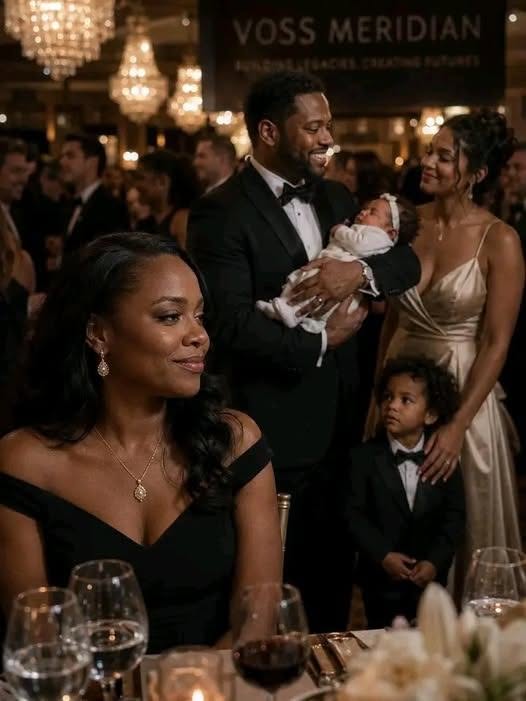
The first time I saw my husband holding his secretary’s second baby, I smiled so calmly that everyone in that ballroom assumed I had died inside. People watched my face the way you watch a window for weather, looking for a crack, a tremor, the first sign of collapse. They found nothing. I had already made my peace with the wreckage. I was not grieving. I was counting.

Martin Voss loved applause more than he loved the truth. He loved applause more than he loved me,more than he loved his company, more than he loved anything that required something difficult inreturn. He was the kind of man who had learned early that beauty and confidence could substitute forhonesty indefinitely, and he had spent his adult life testing that hypothesis against every room he
entered. He was rarely wrong about rooms. Rooms tended to give Martin Voss what he wanted. At the annual charity gala for Voss Meridian, he swept through the main entrance with Clara Hayes on his arm, a toddler named Liam gripping the hem of his jacket and a newborn sleeping against the lapel of his tailored tuxedo, and the room gave him exactly what it always gave him: attention. Cameras flashed
from the press corner. Donors turned. Whispers moved through the gold and ivory space the way whispers always do at events where powerful people are pretending to care about something other than each other. Then Martin lifted the newborn and addressed the nearest cluster of board members and their spouses with his best magnanimous voice, the voice he used for keynote addresses and toast moments and press availability. “My legacy keeps growing,” he said, and he meant it as tenderness, but what he performed was ownership.
Across the gold and ivory ballroom, Clara turned and found me. She smiled. It was the particular smile of a woman who has been winning for so long she no longer needs to gloat; she only needs to confirm that you are still watching.

I was watching.
I was also, if anyone had thought to ask, the woman Martin had spent two years quietly telling people was too fragile to give him children. He never said it loud. He said it the way men like Martin say all damaging things, softly, in sympathy, so that the listening world would think he was protecting me rather than discarding me.
Nine years of marriage. I had built half of what became Voss Meridian before I believed him when he said that a woman who worked and managed and strategized was less desirable than a woman who simply stood beautifully beside him. I had given up my law practice one file at a time, settling clients, closing cases, letting partners absorb what I had spent twelve years building, because Martin said we needed to focus on family, and family meant that his ambitions would expand while mine contracted until there was nothing left of my professional life but the memory of it.
When people at the gala came to press my hand and offer their condolences in the language of polite society, I thanked them with warmth I genuinely felt. I bore no anger toward those people. They were not cruel; they were simply reading the room Martin had arranged. When his mother found me near the bar and squeezed my hand and murmured, low and earnest, “Endure quietly, Evelyn. A man needs heirs,” I nodded. I did not tell her what I knew. When Martin appeared at my shoulder and bent close enough that I could smell his cologne and the faint ghost of something harder underneath it, whisky or ambition or the specific anxiety of a man trying to control too many moving pieces at once, and said, “Don’t embarrass me tonight,” I looked at the two children he was parading through the room and said simply, “I wouldn’t dream of it.”
He understood my quietness as surrender. That was the most important misunderstanding of his life.
Five years earlier, during a fertility consultation Martin had agreed to attend and then abandoned twenty minutes before it began, he had told the doctor’s receptionist to phone his wife. “She handles unpleasant details,” he said, which was his version of delegation and also, I came to understand, a confession about how he had organized our entire marriage. So the doctor called me. I sat in that clinical office alone, listening to a gentle and professional man explain that the results were unambiguous: permanent non-obstructive azoospermia. Not low odds. Not situational. Not the kind of diagnosis that responds to lifestyle changes or supplements or the passage of time. A surgery Martin had undergone as a child, years before we met, had left him permanently unable to father a biological child.


I called Martin six times that afternoon. He did not answer. By the time I finally reached the hotel bar where he spent that particular evening, he was three drinks into whatever version of himself he preferred in moments of avoidance, and he was not alone. Clara Hayes had joined him, still his assistant then, laughing at whatever he was saying with the particular attention of a woman who understands exactly what she is building toward.
I did not confront him that night. I drove home. I sat in the kitchen for an hour before I was capable of crying, and when the crying finally came it was not the operatic kind, not the kind that makes a person feel cleansed or understood. It was the small, exhausting kind that comes from realizing you have been alone in something important for longer than you thought. I cried not because of the diagnosis itself, which I could have carried, but because I had sat alone in a doctor’s office learning something that would restructure the entire architecture of our future, and the man who had put his name on that future had not even glanced at his phone.
Two years after that evening, Clara announced her first pregnancy. Martin came home that night with a brightness in his face I had not seen in years, a particular quality of illuminated pride that I recognized because I had once worked very hard to put it there. He stood in the kitchen doorway and said, with the absolute confidence of a man who has decided to believe something, “See? The problem was never me.”
I looked at him. I let the words settle. I said nothing, because I understood in that moment something cold and clarifying: the truth was available to me, but the truth alone would accomplish nothing. If I produced the medical report and said what I knew, Martin would call me vindictive. Clara would call me barren. His family, including the mother who had told me to endure quietly, would call me desperate and small. The board would hear that Martin’s fragile wife had made a scene. The children, who were innocent, would be caught in a war I had not started.
Silence, I decided, was not weakness. Silence was the room I needed to work in.
I began to pay attention the way lawyers pay attention, specifically, systematically, and without sentiment. I learned where the money went. I requested access to the household accounts under the pretense of managing our charitable giving, which Martin agreed to without interest because finances, when they were not his to spend, bored him. I found invoices for a luxury apartment in the Meridian District coded as client lodging. I found itemized gifts, jewelry, a vehicle, a full renovation of a second-floor nursery, all booked as marketing or business development expenses. I copied everything. I preserved a chain of emails in which Martin had corresponded with the company attorney about amending the family trust to include, and I remember the exact phrasing because I read it many times, the natural children of the Voss union and their primary guardian.
He had not written Clara’s name. He had written language that would hold regardless of what happened between them, language designed to protect the children’s claim to company assets in the event of any future dispute.
What Martin did not know was that the attorney who had originally drafted our prenuptial agreement, the attorney he had dismissed as unnecessary once I left my practice, was me.
I spent three months drafting and quietly amending a clause in the existing marital trust through proper legal channels, working with outside counsel in a city two hours away where no one knew me as Martin Voss’s wife and everyone knew me as the attorney whose work had once been called meticulous by a federal judge in open court. The clause was precise in the way that only someone who has drafted contracts for a living understands precise to mean: not elaborate, not clever, not designed to impress, but airtight in the specific places where airtight mattered. Any attempt to transfer marital or company assets to a partner of an extramarital relationship, any claim of biological paternity contradicted by medical evidence already in the official record, any misuse of corporate funds exceeding a defined threshold and routed through a vendor not subject to standard audit review, each of these events would trigger an automatic forensic audit and freeze all pending amendments to any associated trust or estate document. I had it drafted, reviewed, notarized, registered, and dated eighteen months before the night Martin came home from the charity gala radiating the satisfaction of a man who believes he has finally arranged the world the way he always deserved.
But the clause was only infrastructure. The revelation that changed everything arrived not through my work but through accident, the kind of accident that appears in retrospect to have always been inevitable.
A security photograph. I had hired a private investigator not to expose Martin’s affair, which I already understood in full, but to document the financial irregularities in a way that would be court-admissible. The investigator, doing routine surveillance outside Clara’s building, captured a photograph I had not anticipated. Martin’s younger brother, Adrian Voss, stood on the front steps of Clara’s apartment building, kissing her while she balanced the newborn against his shoulder. On the handle of the stroller beside them, clearly visible in the enlarged image, hung a hospital bracelet. The name printed on it was not Voss. It was Adrian’s surname as registered at birth, which matched the surname he had used professionally before adopting the Voss branding that came with partnership in the family company.
I sat with that photograph for a long time.
Martin had not merely been deceived by a woman who wanted financial security and had chosen him as the vehicle. He had been selected because his ego made him easy. His absolute refusal to receive the medical truth about himself, his willingness to see what he wanted to see rather than what was real, had made him the perfect instrument. Clara and Adrian had built their arrangement behind his certainty, and Martin had held those children in front of the entire charitable community of this city and announced his legacy.
I felt something I had not expected to feel. It was not satisfaction. It was closer to sorrow, the specific grief of watching someone be destroyed by the story they chose to believe about themselves.
The morning after the gala, Martin informed me over breakfast that he was calling an emergency board meeting to address what he called the family narrative, his words for the business of managing how rich people are perceived by other rich people. He wore his navy suit, reserved for acquisitions and funerals. He did not look at me while he spoke. He told me that I had been under strain and that if I said anything inappropriate to board members he would be forced to involve the company’s legal team. He told me that he and Clara were filing the trust amendment that day, and that I would be asked to sign an acknowledgment.
He left without finishing his coffee.
Clara arrived at the Voss Meridian offices an hour after Martin, wearing white the way she had worn it at the gala, which I recognized as a choice. Adrian took his usual seat at the far end of the conference table, which he occupied as a senior partner, and arranged himself with the particular stillness of a man conserving energy for whatever came next.
I entered last.
The room was full. Eight board members, two legal representatives, the company’s chief financial officer, and an assistant whose name I had never learned but whose face I recognized because she had watched me with a cautious sympathy for two years. Martin did not look at me when I entered. He was already speaking, something about continuity and stability and the importance of presenting a unified front to institutional investors.
I set my blue folder on the table.
Martin stopped. He looked at the folder the way people look at something that should not exist in the room where they expected to have total control.
“Evelyn,” he said, warning packed into two syllables.
“I was careful for three years,” I said. I opened the folder. “Today we correct the record.”
I slid the first document to the board chair, a woman named Patricia Hartley who had known Martin since his first year at the company and who had never been comfortable with his management of personal and professional boundaries, though she had been too measured to say so. The document was Martin’s medical report, certified and already provided to the board through outside counsel with appropriate notice the previous week. Then I produced the expense reports with the apartment lease. Then the itemized gifts and their fraudulent business classifications. Then the email chain about the amended trust.
Clara stood before I reached the fourth document. “This is harassment,” she said. “I will not sit here while this woman attacks my children’s future.”
I did not raise my voice. “Harassment is being told by your husband to smile while he parades another woman’s children through a charity gala and announces them as his legacy. What I am doing is presenting evidence.”
Martin’s hand came down on the table. “Those children are mine. Whatever a piece of paper says about biology, I raised them. I love them. That is the only fact that matters today.”
Adrian remained still. He looked at the table.
I turned the last page face-up and slid it slowly to the center of the table where everyone could see it. It was a court-admissible paternity report. Clara had submitted it herself three weeks earlier, believing it was required to activate the children’s educational trust benefits. The form was standard, the processing routine, the result unambiguous. Father: Adrian Voss.
The room did not go quiet. It went a different kind of silent, the silence of eight people recalculating simultaneously.
Martin stared at the paper. He looked at it for a long time without speaking. Then he looked at his brother.
Adrian finally moved. Just a fraction. Just enough.
“Adrian,” Martin said, and the word carried no question in it. It was already an ending.
I tapped the folder. “There is more. Adrian approved the vendor payments that covered the apartment. Clara received them. Martin signed the reimbursement forms without reviewing them, which is either negligence or conspiracy, and the audit committee will determine which. The district attorney’s office has already received copies of the relevant materials.”
Clara’s composure came apart in stages. I watched it happen the way you watch a building’s facade crack from foundation pressure, slowly and then all at once. First her hands, which stopped being still. Then her jaw, which tightened beyond what expression could hide. Then her voice, which came out smaller than I had ever heard it, stripped of the sweetness she deployed the way other people deploy weapons. “Evelyn. The children are innocent. Whatever you think of me, the children are not responsible.”
“I know that,” I said. “They are the only people in this situation who are not responsible. Which is why they have been protected separately.”
I produced one final document. It was a court order establishing an irrevocable educational and welfare trust for both children, funded from the recovered assets, overseen by an independent trustee, and entirely separate from any civil or criminal proceedings against their mother or their biological father. I had filed it two weeks earlier. The judge had signed it the previous Thursday.
Clara stared at it. Whatever she had prepared to say next did not come.
Martin was removed from his position as Chief Executive Officer that afternoon by a board vote of seven to one. The single dissent was Adrian, whose vote was subsequently voided when his suspension was formalized pending the criminal investigation. Patricia Hartley, the board chair who had accepted the first document I slid across the conference table with a steadiness that told me she had been waiting a long time for something like this, moved the vote herself. She did it without theater, which I respected. The subsequent press release was also hers, businesslike and unsentimentalizing, describing the change in leadership as a governance decision in the best interests of the company’s stakeholders and leaving the specific circumstances to the journalists who would find them in the public filings within the week…..
The forensic audit that followed took eleven weeks. It was conducted by an independent firm with no prior relationship to Voss Meridian, which was one of the conditions the board attached to my interim appointment, a condition I had suggested myself because I wanted no question about the integrity of what the audit found. What it found was two million, three hundred thousand dollars routed through a shell company Clara had incorporated under a name that reversed the letters of her own, a small vanity that might have been arrogance or might simply have been the decision of someone who never genuinely believed the money trail would be followed. Adrian had structured the payments across eighteen months, using vendor approval authority he held as a senior partner. Clara had received them into accounts that were not difficult to find once someone was actually looking. Martin had signed the reimbursement forms without reviewing them, which in the legal framework of corporate governance made him either a participant or a catastrophically negligent fiduciary. Neither option was a position from which a chief executive officer could continue to lead a publicly traded company.
Adrian was arrested on a Thursday morning. It was quiet. No press outside the building, no dramatic perp walk, just two men in plainclothes at the lobby desk and Adrian walking toward them in his good coat looking like a man who had known this morning was coming and had decided the only remaining dignity was not to run.
Clara was terminated the same week, named in a civil recovery suit, and ordered by the court to return what she could of the diverted funds. The amount she could return was substantially less than the amount the audit had identified. The gap between those two numbers would follow her through the civil proceedings for years.
Martin came home to find that the keycard to the building management system, which he had used with the unthinking ease of someone who has never had to think about access, no longer worked. He rang the bell. The building manager, a quiet man named Daniel who had worked the lobby for six years and who had always greeted me by name when I returned from the legal appointments I had started making again, let Martin into the lobby and handed him an envelope. Inside was my petition for divorce, filed that morning through the firm I had rejoined six weeks earlier when it became clear that the proceedings were reaching their resolution and that I would need my name on a letterhead again.
He found me in the sitting room. I was reading. He stood in the doorway for a long moment with the envelope held loosely in one hand, and he had the look of a man who has run out of the specific kind of forward momentum that had organized his entire life, the momentum that comes from never stopping long enough to reckon with anything.
“You ruined me,” he said.
I put down my book.
I thought about the night I had sat alone in a doctor’s office while he drank in a hotel bar. I thought about the morning he stood in the kitchen and said see, the problem was never me, with that particular brightness in his face, the illumination of a man who has decided to replace an inconvenient truth with a convenient story and found the substitution effortless. I thought about every gala, every charity dinner, every board presentation where I had stood at the appropriate distance and smiled the appropriate smile while he constructed a version of our life that made me smaller each year, not through violence or even conscious cruelty, but through the simple, persistent pressure of a man who needed the room to himself and had found in me someone willing to step back indefinitely.
I thought about his mother’s hand on mine. Endure quietly. As if endurance without purpose was a kind of virtue, as if the goal was simply to last rather than to matter.
I thought about the photograph of two children who had nothing to do with any of it, sleeping in a hospital room with a bracelet on their wrist that told a story their mother and their biological father had worked carefully to obscure from the man who had wanted so badly to believe he was at the center of everything important. I thought about how that wanting, that absolute refusal to receive a reality that diminished him, had made Martin Voss the most useful fool in a room full of people who understood exactly what he was.
“No,” I said. “You built everything you built on what you wanted to believe rather than what was real. I simply waited until the weight of it became unsustainable. Then I removed the floor.”
He looked at me for a long moment. He was not a man accustomed to being seen clearly, and I think in that moment he understood something about the nine years behind us that he had not understood before. I do not know if it was remorse. I do not know if men like Martin Voss are capable of the specific kind of remorse that requires acknowledging not just what they did but what they chose not to see. What I know is that he left that evening without another word, and the divorce was finalized five months later without contest.
Six months after the gala, I walked through the main lobby of Voss Meridian’s headquarters on a Tuesday morning and took the elevator to the executive floor. My name was on the glass beside the door at the end of the hall where his used to be. Interim Chairwoman. I had accepted the position not because I wanted Martin’s chair specifically but because I knew the company, had helped build it before I became its most presentable accessory, and because four hundred and sixty employees deserved leadership from someone who understood what the company was actually for rather than what it could be used to display.
The company survived. The institutional investors, after the initial alarm and the press coverage and the short period of market volatility that follows any executive misconduct story, stayed. The company’s fundamentals were sound. They had always been sound. That was not Martin’s doing; it was the doing of the people who had worked there without drama or performance for years. I thanked them in my first all-staff address, and I meant it without qualification.
The children’s trust remained fully funded. They would have their education regardless of what happened to their parents in civil court. I had made certain of that before any other document was filed, because they had come into a complicated situation without choosing it, and the least I could do for them was make sure the adults’ failures did not follow them into classrooms.
Martin lived in a rented apartment across the city. His membership at the club where he had conducted most of his business lunches for a decade was quietly not renewed. He was not destitute; the divorce settlement was fair, drawn up with the specific fairness of someone who wanted it to be unimpeachable rather than punishing. He had enough to live comfortably and rebuild something modest, if he chose to. Whether he chose to was no longer a question I needed to follow.
Clara sold designer goods online and was appealing the civil judgment. Adrian was awaiting sentencing. His lawyer was working on cooperation arguments that I understood were not proceeding well, because the forensic evidence did not leave much room for minimization.
I slept well. I had slept well since the Thursday the judge signed the children’s trust, which was the moment I understood that everything I had set in motion had arrived at the place I intended. I slept without the low hum of unfinished calculations that had been the background sound of my life for three years.
Not because I had been cruel. I had not been cruel. I had been precise.
Not because I had wanted revenge. What I had wanted, if I am honest, was to be believed, and the evidence had accomplished that without requiring me to perform grief in front of people who would have found it convenient to dismiss.
What I understood, lying in the quiet of the bedroom that was now entirely mine, was that silence had not been my defeat. Silence had been the condition under which the truth became undeniable. I had not screamed. I had not begged. I had not asked anyone to take my word for anything. I had simply gathered what was real and waited until the room was ready to see it.
Martin had mistaken my stillness for the absence of motion. He was wrong. Still water runs deep, and I had been running, purposefully and without interruption, for three years.
The morning after my first full week as interim chairwoman, I arrived early. The building was quiet. The lobby staff nodded. I rode the elevator alone to the executive floor, walked to the corner office, and stood at the window for a few minutes looking at the city coming awake below, the traffic and the light and the ordinary enormity of people moving through their lives.
I thought about who I had been nine years earlier, the woman who had dissolved her law practice file by file because a man she loved told her that love required contraction. I thought about how long I had believed that quietness and accommodation were the same thing as wisdom.
They are not the same thing. Wisdom knows what it is waiting for. Accommodation simply waits.
I had been wise without knowing it, and now I knew it, and the knowing was not triumphant in the way that stories about women like me are sometimes told. It was quieter than that. It was the feeling of occupying space that had always been available to me and choosing, finally, not to make myself smaller than it required.
I opened my laptop. I had a board call in forty minutes, a review of the recovered asset allocation in the afternoon, and a dinner with the firm’s managing partner in the evening to discuss formally restoring my name to the letterhead.
There was a great deal of work to do.
I was ready for all of it…..
SIX MONTHS LATER
Six months after the divorce, Martin Voss stood in line at a grocery store holding a basket with three items.
Milk.
Bread.
Coffee.
The cashier didn’t recognize him.
A year earlier, people had crossed rooms to shake his hand.
Now nobody looked twice.
The realization should have hurt.
Instead, it exhausted him.
His phone buzzed.
Not a board member.
Not an investor.
Not a journalist.
His mother.
Martin stared at the screen before answering.
“Hello?”
For several seconds, she said nothing.
Then she asked quietly, “Have you spoken to Evelyn?”
Martin laughed once.
A broken sound.
“Why would she want to hear from me?”
His mother sighed.
Because for the first time in his life, Martin Voss was beginning to understand that losing money was not the same thing as losing respect.
Money could return.
Respect rarely did.
Across the city, Evelyn stepped out of a town car in front of Voss Meridian headquarters.
Employees greeted her by name.
Not because they feared her.
Because they trusted her.
The difference mattered.
As she entered the building, Patricia Hartley caught up beside her.
“Ready for the shareholder meeting?”
Evelyn smiled.
“Always.”
Patricia handed her a folder.
“Good.”
Then she paused.
“There is one more thing.”
Evelyn raised an eyebrow.
Patricia smiled.
“You just received an offer to become permanent Chairwoman.”
For the first time that morning, Evelyn stopped walking.
The future had arrived.
And it belonged entirely to her.
PART 4: THE SHAREHOLDER MEETING
The shareholder meeting took place three weeks later.
For years, Martin Voss had treated the annual gathering like a personal coronation.
The stage.
The spotlight.
The applause.
He had loved every second of it.
This year, he sat in the back row.
No reserved seat.
No executive badge.
No speech.
No power.
Just another shareholder among hundreds.
The irony was almost poetic.
Martin arrived early, hoping to avoid attention.
It didn’t work.
People noticed.
They always noticed fallen kings.
Conversations stopped when he passed.
Some faces showed pity.
Others showed satisfaction.
Most showed nothing at all.
Indifference hurt more than either.
At ten o’clock sharp, the lights dimmed.
The giant screen behind the stage illuminated.
The company’s logo appeared.
Then Evelyn walked onto the platform.
The room erupted into applause.
Not polite applause.
Not obligatory applause.
Real applause.
Martin felt something tighten inside his chest.
For years he had convinced himself that people respected Evelyn because she was his wife.
Now he sat in silence while hundreds of investors stood to applaud a woman who no longer carried his name.
She wore a dark blue suit.
No expensive jewelry.
No dramatic entrance.
No performance.
Just confidence.
The kind that didn’t need witnesses.
“Good morning,” she began.
The room quieted instantly.
Martin noticed something he had never noticed before.
People listened differently when Evelyn spoke.
When he spoke, they listened because he demanded attention.
When she spoke, they listened because they trusted her.
The distinction suddenly felt enormous.
Over the next hour, Evelyn presented the company’s recovery plan.
Revenue projections.
Audit results.
Governance reforms.
Future expansion.
Everything was precise.
Organized.
Transparent.
By the time she finished, even the most skeptical investors appeared satisfied.
Then came the vote.
Patricia Hartley stepped forward.
“The Board of Directors recommends the appointment of Evelyn Hartwell as Permanent Chairwoman and Chief Executive Officer of Voss Meridian.”
A murmur swept through the room.
Patricia continued.
“Votes have already been submitted electronically. Results will now be announced.”
Martin stared at the screen.
He didn’t know why.
Maybe because some small foolish part of him still believed the universe would correct itself.
Maybe because losing once had not been enough.
The numbers appeared.
Approval: 94.7%
Opposed: 5.3%
The room exploded with applause.
Evelyn remained composed.
But Martin saw the brief surprise in her eyes.
Even she hadn’t expected such overwhelming support.
Patricia smiled.
“Congratulations, Madam Chairwoman.”
The title echoed through the hall.
Madam Chairwoman.
Not Mrs. Voss.
Not Martin’s wife.
Not the woman standing beside the powerful man.
The powerful man.
Martin left before the meeting ended.
No one stopped him.
No one followed.
Outside, rain had begun to fall.
He stood beneath the building’s awning staring across the street.
For a long time he didn’t move.
Then he heard someone say his name.
“Martin.”
He turned.
His mother stood there.
Elegant as always.
Perfect posture.
Perfect clothes.
But something about her seemed older.
Tired.
She looked at the headquarters building.
Then back at him.
“You know,” she said softly, “I used to tell Evelyn to endure quietly.”
Martin said nothing.
“I thought I was protecting the family.”
Rain tapped against the pavement.
“I was wrong.”
Those three words stunned him more than anything else she had said.
His mother never admitted mistakes.
Never.
Yet here she stood doing exactly that.
She looked toward the glass tower again.
“She didn’t destroy this family, Martin.”
Her eyes met his.
“We did.”
Then she walked away.
Leaving him alone beneath the rain-dark sky.
Across the street, on the top floor of Voss Meridian, Evelyn stood in her new office.
The celebration downstairs continued.
Employees laughed.
Investors congratulated one another.
Phones rang with media requests.
But Evelyn wasn’t looking at any of it.
She was looking at a small photograph on her desk.
Two children smiling at a playground.
Liam and his little sister.
The trust fund reports had arrived that morning.
Their education accounts were secure.
Their future was protected.
Exactly as she had promised.
A soft knock came at the door.
“Come in.”
Patricia entered holding another folder.
Evelyn smiled.
“Please tell me that’s the last folder for today.”
Patricia laughed.
“I’m afraid not.”
She placed it on the desk.
Evelyn opened it.
Her smile disappeared.
The folder contained documents from a private investigator.
Recent documents.
Very recent.
The top photograph showed Clara Hayes meeting secretly with someone outside the city.
A man neither of them recognized.
Patricia’s expression turned serious.
“The investigator thinks she’s hiding money.”
Evelyn studied the image.
“No.”
Patricia frowned.
“No?”
Evelyn looked closer.
The man wasn’t a banker.
He wasn’t a lawyer.
And he definitely wasn’t helping Clara hide assets.
Evelyn recognized him.
Because she had seen his face once before.
Years ago.
In Martin’s medical file.
The room suddenly felt very quiet.
Patricia noticed the change in her expression.
“What is it?”
Evelyn slowly placed the photograph on the desk.
Then she whispered five words.
“Oh my God…”
Patricia stared.
“Evelyn?”
Evelyn didn’t answer immediately.
Because for the first time in three years…
She had just found a secret she hadn’t known existed.
PART 5: THE NAME IN THE FILE
Patricia closed the office door.
“Evelyn.”
Her voice was calm, but concerned.
“What did you see?”
Evelyn stared at the photograph.
The man standing beside Clara was older now.
Gray hair.
Thin face.
Wire-rimmed glasses.
But she knew that face.
She had seen it once before.
Five years ago.
Inside Martin’s fertility records.
Specifically, on the consultation report from the clinic.
At the bottom of the page.
Attending Specialist:
Dr. Leonard Mercer.
For several seconds, Evelyn said nothing.
Then she slid the photograph across the desk.
Patricia looked down.
“You know him?”
“I think I do.”
Patricia’s eyes narrowed.
“Who is he?”
Evelyn took a slow breath.
“The doctor who diagnosed Martin.”
The room went completely silent.
Patricia blinked.
“What?”
“The fertility specialist.”
Patricia looked from the photograph back to Evelyn.
“The same doctor who confirmed Martin couldn’t father children?”
“Yes.”
Patricia sat down.
Neither woman spoke for a moment.
Because there was only one obvious question.
Why would Clara be meeting him now?
Five years later?
After everything had already collapsed?
After the lawsuits?
After the audits?
After Martin lost everything?
It made no sense.
And when something made no sense, Evelyn had learned to keep digging.
“Get me everything,” she said.
Patricia nodded.
“I’ll call the investigator.”
By evening, the first report arrived.
Dr. Leonard Mercer had officially retired three years earlier.
He no longer practiced medicine.
He no longer consulted.
He no longer appeared on any hospital payroll.
Yet over the previous six months, he had received multiple private payments.
Large ones.
All routed through accounts connected to shell corporations.
One of those corporations had links to Clara.
Patricia stared at the numbers.
“That’s impossible.”
“No,” Evelyn said quietly.
“It’s very possible.”
Patricia looked at her.
“You think he took bribes?”
“I don’t know.”
Evelyn leaned back.
“But I know one thing.”
She tapped the photograph.
“People don’t secretly pay retired doctors thousands of dollars for no reason.”
The next morning, Martin received a phone call.
He almost ignored it.
Most calls lately involved debt collection, reporters, or lawyers.
But when he saw the caller ID, he froze.
Evelyn.
The first call she had made to him in months.
He answered immediately.
“Hello?”
“Evelyn?”
Her voice was businesslike.
“We need to talk.”
Martin laughed bitterly.
“About what?”
“Your medical records.”
The silence that followed lasted nearly ten seconds.
“What about them?”
“I think there may be a problem.”
Martin’s heart began to pound.
“A problem?”
“Meet me at my office.”
“Evelyn—”
“Tomorrow. Nine o’clock.”
Then she hung up.
Martin spent the entire night staring at the ceiling.
By morning, he looked exhausted.
At exactly nine o’clock, he entered Voss Meridian headquarters.
The same building he had once ruled.
Employees barely glanced at him.
The elevator ride felt longer than he remembered.
When he entered Evelyn’s office, Patricia was already there.
A thick folder sat on the desk.
Martin looked at it uneasily.
“What is this?”
Evelyn folded her hands.
“A question.”
Martin frowned.
“What question?”
Evelyn opened the folder.
She removed the photograph.
The one showing Clara and Dr. Mercer.
Martin stared.
His face immediately changed.
“I know him.”
“I know.”
Evelyn slid the photograph toward him.
“We’ve been trying to figure out why Clara is meeting with the doctor who diagnosed your infertility.”
Martin looked confused.
Then annoyed.
“Who cares?”
Evelyn watched him carefully.
“I do.”
Patricia added quietly:
“So should you.”
Martin’s irritation slowly faded.
Something colder replaced it.
“What are you saying?”
Evelyn reached into the folder.
Then she placed another document on the desk.
A bank transfer record.
Several large payments.
All sent to Dr. Mercer.
All connected to Clara.
Martin stared.
His eyes moved back and forth across the page.
Once.
Twice.
Three times.
Then he whispered:
“No.”
Evelyn said nothing.
“No.”
His voice became louder.
“No.”
Patricia remained silent.
Martin pushed away from the desk.
“This is ridiculous.”
“Maybe.”
Evelyn’s voice remained calm.
“Which is why we’re going to verify it.”
Martin looked at her.
For the first time in years, she saw genuine fear.
Not anger.
Not arrogance.
Fear.
Because there was only one possibility worse than discovering the children weren’t his.
Discovering that they might be.
The realization hit him like a physical blow.
His face went pale.
“Evelyn…”
He could barely speak.
“You think the diagnosis was wrong?”
“I don’t know.”
“But I intend to find out.”
The room became silent again.
Martin slowly lowered himself back into the chair.
His hands trembled.
Five years.
Five years of believing one thing.
Five years of humiliation.
Five years of lies.
Five years that had destroyed everything.
And now…
Someone was suggesting the foundation of the entire story might be false.
Finally, Martin looked up.
“What do we do?”
Evelyn held his gaze.
For the first time since the divorce, there was no hostility between them.
Only uncertainty.
“We get the truth.”
Outside the office window, the city continued moving.
Traffic flowed.
People hurried to work.
Ordinary life continued.
But inside that office, a new investigation had just begun.
And none of them yet understood how dangerous the answers would become.
Because three hours later…
Dr. Leonard Mercer disappeared…
THE DISAPPEARING DOCTOR
By four o’clock that afternoon, Dr. Leonard Mercer’s house was empty.
Not abandoned.
Emptied.
There was a difference.
The investigator Patricia hired arrived first.
He called Evelyn immediately.
“The car is gone.”
“What about Mercer?”
“No sign of him.”
Evelyn stood beside her office window.
“What else?”
A pause.
Then:
“The neighbors say movers were here this morning.”
Evelyn’s grip tightened on the phone.
“This morning?”
“About an hour after someone visited him.”
“Who?”
“We’re pulling security footage now.”
Evelyn hung up.
Something was wrong.
Very wrong.
People did not vanish overnight unless they expected trouble.
Or caused it.
Thirty minutes later, Martin arrived at her office unannounced.
He looked terrible.
He had not slept.
His tie hung loose.
His eyes were bloodshot.
For years Evelyn had imagined what it would look like when certainty finally abandoned him.
Now she knew.
It looked exhausted.
“Any news?” he asked.
Evelyn nodded.
“Mercer disappeared.”
Martin froze.
“What?”
“He emptied his house.”
“When?”
“This morning.”
Martin sank into a chair.
Neither spoke for several seconds.
Finally he asked:
“Do you think Clara warned him?”
Evelyn considered it.
“Possibly.”
Patricia entered carrying a tablet.
“We have the footage.”
Everyone turned toward her.
She placed the tablet on the desk.
The screen showed security-camera footage from outside Mercer’s neighborhood.
A black sedan appeared at 7:14 a.m.
The vehicle stopped outside the doctor’s home.
A man exited.
Tall.
Dark coat.
Baseball cap.
The footage was grainy.
But the moment he turned sideways, Evelyn felt her stomach tighten.
Martin leaned forward.
His face drained of color.
“No.”
Patricia looked at him.
“You recognize him?”
Martin nodded slowly.
The room became silent.
Because the man on the screen wasn’t Clara.
Wasn’t Adrian.
Wasn’t anyone from Voss Meridian.
It was Martin’s father.
Richard Voss.
The founder of the company.
The man who supposedly knew nothing about any of this.
The man who had spent the last year quietly retired in Arizona.
Patricia looked stunned.
“I thought he was out of state.”
“So did I,” Martin whispered.
Evelyn watched the footage again.
Richard entered the house.
Thirty-seven minutes later, he left.
At 9:02 a.m., movers arrived.
By noon, Mercer was gone.
Nobody spoke.
Because the implications were enormous.
Finally Evelyn broke the silence.
“Find him.”
The investigator worked through the night.
At 11:48 p.m., he called.
“We found Mercer.”
Evelyn sat upright.
“Where?”
“A private airfield outside the city.”
Her pulse quickened.
“And?”
“He never boarded the plane.”
Evelyn frowned.
“What do you mean?”
The investigator sounded uneasy.
“The plane left.”
“Without him?”
“Without him.”
The silence on the line grew heavy.
Then he added:
“The strange part is that someone else did.”
The next morning, Evelyn, Martin, and Patricia reviewed the airfield footage.
A private jet waited on the runway.
Mercer’s luggage was loaded aboard.
His passport had been processed.
His flight plan had been filed.
Everything suggested he intended to leave the country.
Yet when the aircraft departed…
The passenger wasn’t Mercer.
It was Clara.
Patricia stared at the screen.
“What the hell?”
Martin looked equally confused.
“Why would Clara use his flight?”
Nobody had an answer.
Until Evelyn noticed something.
A small detail.
Tiny.
Easy to miss.
She paused the footage.
Zoomed in.
And stared.
Patricia leaned closer.
“What is it?”
Evelyn pointed.
“The suitcase.”
Martin frowned.
“What about it?”
“That’s not Clara’s luggage.”
The room fell silent.
Because Evelyn recognized it.
Years ago, during one of Martin’s executive retreats, she had bought him a custom leather travel case.
Italian leather.
Handmade.
One of a kind.
The initials burned into the handle were still visible.
M.V.
Martin stared.
His heartbeat quickened.
“That’s mine.”
Patricia slowly looked up.
“Then why does Clara have it?”
Nobody answered.
Because another possibility had just emerged.
One that none of them liked.
What if Clara wasn’t running?
What if someone was helping her disappear?
And what if that someone wasn’t Mercer?
Martin suddenly stood.
“Evelyn.”
His voice sounded different.
Almost frightened.
“What?”
He swallowed.
Then pointed toward the paused image.
Not at Clara.
Not at the suitcase.
At the man helping load the luggage.
A man whose face was partly hidden beneath a cap.
Patricia zoomed in.
The image sharpened.
Evelyn stared.
Then her blood ran cold.
Because she recognized him immediately.
So did Martin.
It wasn’t a stranger.
It wasn’t an employee.
It wasn’t a lawyer.
It was someone they had both attended a funeral for three years ago.
A man officially declared dead.
And yet there he was.
Standing on the runway.
Alive.
Watching Clara board the plane.
Smiling.
The room became completely silent.
Then Martin whispered the only words anyone could think to say.
“That’s impossible.”
PART 7: THE MAN WHO SHOULD HAVE BEEN DEAD
For several seconds, nobody spoke.
The frozen image remained on the screen.
The man standing beside the aircraft looked older.
Thinner.
His hair had gone gray.
But the face was unmistakable.
Martin took a step closer.
“No.”
Patricia looked between him and Evelyn.
“You know him?”
Martin laughed once.
It sounded almost painful.
“I buried him.”
The words hung in the room.
Three years earlier, Victor Kane had died in a boating accident off the Oregon coast.
At least that was the official story.
Victor had once been Voss Meridian’s Chief Financial Officer.
He had resigned suddenly after a dispute with Martin’s father.
Six months later, he was dead.
Or so everyone believed.
Evelyn remembered the funeral.
Closed casket.
Small attendance.
A grieving sister who spoke to nobody.
A death certificate.
Insurance filings.
Everything had appeared legitimate.
Yet the man standing on the runway was Victor Kane.
Alive.
Patricia slowly sat down.
“What does this mean?”
Evelyn stared at the screen.
“It means this started long before Clara.”
Martin looked sick.
His eyes remained fixed on Victor’s face.
“Victor handled the company books.”
Evelyn looked at him.
“What kind of books?”
Martin hesitated.
Then answered.
“The books my father never let anyone else see.”
The room fell silent.
Because suddenly Richard Voss’s appearance at Dr. Mercer’s house made much more sense.
A retired doctor.
A fake diagnosis.
A dead executive.
Hidden payments.
The pieces were beginning to connect.
And every connection pointed toward one person.
Richard Voss.
Martin’s father.
The founder.
The man who had built the company.
The man who had spent decades controlling every narrative around him.
Patricia broke the silence.
“What if Richard knew about the diagnosis?”
Evelyn’s expression darkened.
“What if he arranged it?”
Martin turned toward her.
“Why?”
Evelyn answered immediately.
“Control.”
Neither of them spoke.
Because the possibility was horrifying.
Richard Voss had always cared about one thing above all else:
The company.
Its image.
Its future.
Its bloodline.
If Martin had been diagnosed as infertile years earlier, Richard might have believed his son could never produce an heir.
And if Richard believed that…
What lengths would he go to preserve the family legacy?
Martin suddenly sat down.
Hard.
As if the strength had left his legs.
“My God.”
Evelyn looked at him.
“What?”
His voice barely rose above a whisper.
“The timing.”
Patricia frowned.
“What timing?”
Martin swallowed.
“The diagnosis.”
Evelyn waited.
Martin stared at the floor.
Then finally looked up.
“My father was the one who recommended Dr. Mercer.”
Nobody moved.
Nobody blinked.
Because everything had just changed.
The doctor.
The diagnosis.
The years of lies.
The children.
The affair.
The collapse of a marriage.
The destruction of a company.
All of it suddenly traced back to a single decision made five years earlier.
A recommendation from Richard Voss.
And for the first time since this began, Evelyn felt something she had not felt in years.
Not anger.
Not satisfaction.
Fear.
Because if Richard Voss truly orchestrated any part of this…
Then neither she nor Martin had ever understood the game they were playing.
And somewhere, on a private jet crossing the Pacific Ocean, Clara Hayes sat beside a man who was supposed to be dead.
Carrying secrets that could destroy what remained of the Voss family forever.
PART 8: RICHARD VOSS SPEAKS
Richard Voss arrived at Voss Meridian headquarters the following afternoon.
He did not call ahead.
He did not ask permission.
At seventy-four years old, he still moved through the building as though it belonged to him.
In many ways, it had.
Employees stared as he crossed the lobby.
Some recognized him immediately.
Others knew him only from photographs hanging in conference rooms and annual reports.
The founder.
The legend.
The man who built the empire.
By the time he stepped off the executive elevator, Evelyn, Martin, and Patricia were waiting.
Richard looked at each of them calmly.
Then his eyes settled on the photograph lying on Evelyn’s desk.
Victor Kane.
Alive.
For the first time, something flickered across Richard’s face.
Not surprise.
Recognition.
Evelyn noticed immediately.
“So you do know him.”
Richard remained silent.
Martin stepped forward.
“You told everyone he was dead.”
Richard’s gaze shifted to his son.
“I told everyone what I was told.”
“Don’t lie to me.”
The words came out sharper than Martin intended.
But years of humiliation and confusion had finally reached the surface.
Richard’s expression hardened.
“Careful.”
Martin laughed bitterly.
“No.”
The older man blinked.
Martin continued.
“For thirty years I’ve been careful.”
The room fell silent.
“I’ve been careful with my words.”
“Careful with my opinions.”
“Careful not to disappoint you.”
His voice shook.
“But look where that got me.”
Richard said nothing.
Evelyn watched carefully.
Because this was the first honest conversation she had ever witnessed between father and son.
Martin pointed toward the photograph.
“Who is Victor working for?”
Richard answered immediately.
“Himself.”
“No.”
Martin shook his head.
“Try again.”
A long silence followed.
Finally Richard sighed.
For the first time, he looked tired.
Older.
Human.
Then he sat down.
“You deserve part of the truth.”
Evelyn exchanged a glance with Patricia.
Part of the truth.
Not all of it.
Richard was still choosing his words.
Still controlling the room.
Still managing information.
Some habits never died.
“Victor discovered irregularities fifteen years ago.”
Patricia frowned.
“What kind of irregularities?”
Richard looked toward the window.
“Acquisition fraud.”
The room went still.
Voss Meridian had completed dozens of acquisitions over the years.
Some worth hundreds of millions.
Others worth far more.
Evelyn felt her pulse quicken.
“Who committed the fraud?”
Richard’s jaw tightened.
Then he answered.
“Someone inside the company.”
Martin stared.
“Who?”
Richard looked directly at him.
“You.”
The room exploded.
“What?”
Martin nearly shouted the word.
Richard raised a hand.
“Not intentionally.”
Martin’s face reddened.
“What are you talking about?”
Richard folded his hands.
“When you became Vice President, you signed hundreds of documents.”
Martin frowned.
“Of course I did.”
“You signed them without reading them.”
Martin froze.
Because it was true.
Richard continued.
“Victor discovered that several acquisitions contained falsified valuations.”
Patricia looked horrified.
“Millions?”
Richard shook his head.
“Hundreds of millions.”
Nobody spoke.
Evelyn’s legal mind was already racing.
“You’re saying someone used Martin’s signatures?”
“Yes.”
“And Victor found it?”
Richard nodded.
“Yes.”
Martin stared at his father.
“Then why didn’t you tell me?”
Richard looked away.
The answer came quietly.
“Because I didn’t know who was responsible.”
Patricia frowned.
“So you buried it?”
“No.”
Richard’s voice became cold.
“I investigated.”
Evelyn studied him.
There was something he wasn’t saying.
Something important.
“Who was your suspect?”
Richard looked directly at her.
Then he said two words.
“Victor Kane.”
Silence.
Heavy silence.
The kind that settles into a room and refuses to leave.
Patricia blinked.
“You thought Victor committed the fraud?”
“I still do.”
Martin stared.
“But he’s alive.”
“Exactly.”
Richard leaned forward.
“He vanished with evidence.”
The room grew quiet again.
Richard continued.
“He staged his death.”
“He disappeared.”
“And now he suddenly reappears alongside Clara Hayes.”
His eyes moved between them.
“That is not a coincidence.”
Evelyn folded her arms.
“You expect us to believe Clara somehow found a man who disappeared three years ago?”
Richard’s answer came instantly.
“No.”
Evelyn narrowed her eyes.
“Then what do you believe?”
The founder of Voss Meridian looked at the photograph once more.
Then spoke the words that changed everything.
“I believe Victor found Clara.”
Nobody moved.
Nobody breathed.
Because if that was true…
Then Clara had never been the mastermind.
She had been recruited.
Used.
Positioned.
Just like Martin.
Just like Adrian.
Maybe even just like Richard himself.
Patricia slowly sat back.
“My God.”
Richard nodded.
“Yes.”
Then he looked at Evelyn.
And for the first time since entering the office, genuine concern appeared in his eyes.
“You think this story started with an affair.”
Evelyn felt a chill run through her body.
Because Richard sounded absolutely certain.
“It didn’t.”
He pointed at Victor’s photograph.
“It started fifteen years ago.”
Then he reached into his coat pocket.
And placed a worn flash drive on Evelyn’s desk.
“I’ve spent fifteen years waiting for the right person to see this.”
Evelyn stared at it.
“What is it?”
Richard’s answer was simple.
“The reason Victor Kane had to disappear.”
The room became completely silent.
Because everyone suddenly understood the same thing.
The flash drive mattered more than the affair.
More than Clara.
More than Adrian.
Possibly even more than Martin’s medical records.
And whatever was on it…
Someone had spent fifteen years trying to keep it buried…
THE FLASH DRIVE
Nobody touched the flash drive.
Not immediately.
It sat in the center of Evelyn’s desk like a small piece of unexploded ordnance.
Richard Voss stared at it.Martin stared at it.
Patricia stared at it.
Finally, Evelyn picked it up.
“You’ve had this for fifteen years?”
Richard nodded.
“Fourteen years and eight months.”
“Why keep it?”
A shadow crossed his face.
“Because once I saw what was on it, I stopped knowing who I could trust.”
The room fell silent.
Evelyn walked to her laptop.
She inserted the drive.
A password screen appeared.
Twenty-seven characters.
Patricia looked at Richard.
“You memorized that for fifteen years?”
“I never forgot it.”
Richard stepped forward.
Slowly typed the password.
The drive unlocked.
Hundreds of files appeared.
Emails.
Contracts.
Bank transfers.
Meeting recordings.
Audit reports.
Thousands of pages.
Evelyn opened the first folder.
The date caught her attention immediately.
Fourteen years earlier.
Long before Clara.
Long before the children.
Long before the affair.
Long before Evelyn had even left her law practice.
She clicked a file.
A spreadsheet opened.
Then another.
Then another.
Patricia suddenly leaned forward.
“Oh my God.”
Martin frowned.
“What?”
Patricia pointed at the screen.
“These acquisition numbers.”
Evelyn froze.
Because she saw it too.
The fraud Richard described wasn’t theft.
Not exactly.
The company hadn’t been losing money.
Someone had been creating money.
Artificially inflating company values before acquisitions.
Selling assets at manipulated prices.
Moving profits through subsidiaries.
Making ordinary transactions appear extraordinary.
For years.
Richard watched their reactions carefully.
“You understand now.”
Evelyn slowly looked up.
“This wasn’t a rogue employee.”
“No.”
“This required multiple executives.”
“Yes.”
Patricia swallowed.
“How many?”
Richard’s answer was immediate.
“At least seven.”
The room became quiet.
Seven senior executives.
Seven people with enough authority to hide hundreds of millions of dollars.
Seven people who had likely spent years protecting one another.
Martin rubbed his face.
“This would have destroyed the company.”
“It still might.”
The answer came from Evelyn.
Everyone looked at her.
She continued scrolling through the files.
Then she stopped.
A name appeared.
One she recognized instantly.
Patricia saw it too.
Her face went pale.
“No.”
Martin frowned.
“What?”
Patricia pointed at the screen.
The name belonged to someone still working at Voss Meridian.
Someone trusted.
Someone respected.
Someone who had survived every leadership change.
Every audit.
Every scandal.
Every investigation.
Someone who currently sat on the board.
Harold Bennett.
The longest-serving director in company history.
Richard nodded slowly.
“He was one of them.”
Martin looked stunned.
“Harold?”
“The same Harold who taught me how to negotiate contracts?”
“Yes.”
“The same Harold who voted to remove me?”
“Yes.”
Martin stared at the screen.
Unable to process it.
Harold Bennett had been with the company for nearly thirty years.
He attended every holiday party.
Every shareholder meeting.
Every board retreat.
He was practically family.
Evelyn continued searching.
Then she found something else.
An audio recording.
She clicked play.
Static filled the room.
Then voices.
Old voices.
Younger voices.
A meeting.
Someone laughed.
Someone mentioned offshore accounts.
Then another voice spoke.
A voice everyone in the room recognized immediately.
Harold Bennett.
The room froze.
The recording continued.
“…if Richard ever finds out, we’re finished.”
Another man laughed.
“He won’t.”
Then came a third voice.
Calm.
Confident.
Dangerously familiar.
Victor Kane.
The room fell completely silent.
Because Victor wasn’t exposing the fraud.
He was participating in it.
Patricia looked at Richard.
“You were right.”
Richard didn’t look pleased.
He looked exhausted.
As if being proven right after fifteen years felt less like victory and more like confirmation of an old wound.
Martin sat heavily in his chair.
“Then why disappear?”
Richard answered quietly.
“Because somebody betrayed somebody.”
Evelyn paused the recording.
Her legal instincts were screaming now.
Something still didn’t fit.
The numbers.
The fraud.
Victor.
Harold.
The fake death.
The affair.
The doctor.
They connected.
But not completely.
There was still a missing piece.
Then she opened the final folder.
The folder had no name.
Just a date.
Three years ago.
The year Victor supposedly died.
Inside was a single video file.
Nothing else.
Everyone watched as Evelyn clicked it.
The video began.
A hotel room.
Poor lighting.
Shaky camera.
Victor Kane sat alone at a table.
He looked terrified.
Not cautious.
Terrified.
The timestamp showed it was recorded two days before his supposed death.
Victor looked directly into the camera.
Then he spoke.
“If you’re watching this, I either disappeared…”
He paused.
“…or they finally killed me.”
Nobody moved.
Victor continued.
“The fraud is real.”
Richard closed his eyes.
Patricia gripped the edge of the desk.
Martin stared at the screen.
Then Victor spoke the sentence that changed everything.
“But Harold Bennett isn’t the leader.”
The room froze.
Victor leaned closer to the camera.
“The person running everything…”
His voice dropped to a whisper.
“…is a member of the Voss family.”
Silence.
Absolute silence.
Then the video ended.
Just ended.
No explanation.
No name.
Nothing.
The screen went black.
For several seconds, nobody breathed.
Then Martin slowly turned toward his father.
Richard looked genuinely shocked.
Patricia looked terrified.
Evelyn stared at the dark screen.
Because the Voss family only had three living members connected to the company.
Richard.
Martin.
And Adrian.
One of them had been at the center of a fifteen-year conspiracy.
And somewhere in the world, Victor Kane was still alive.
Meaning he probably knew which one.
PART 10: THE NAME NOBODY WANTED
Nobody spoke for nearly a minute.
The black screen reflected their faces back at them.
Richard looked stunned.
Patricia looked frightened.
Martin looked sick.
Evelyn looked thoughtful.
Because panic never solved anything.
Evidence did.
Finally, she broke the silence.
“Play it again.”
The video restarted.
Victor appeared.
Tired.
Terrified.
Older than his years.
Everyone listened carefully.
Every word.
Every pause.
Every breath.
When the recording ended a second time, Evelyn closed the laptop.
“He’s telling the truth.”
Martin stared.
“How do you know?”
“Because liars add details.”
She folded her hands.
“Victor didn’t.”
Patricia nodded slowly.
Evelyn continued.
“He gave only one piece of information.”
A member of the Voss family.
Nothing more.
Nothing less.
Richard sat heavily in a chair.
“There are only three possibilities.”
Martin looked at him.
“You.”
Richard nodded.
“You.”
Then his eyes moved toward the empty chair Adrian once occupied.
“And Adrian.”
The room became silent again.
Three names.
Three suspects.
One family.
Martin laughed bitterly.
“Wonderful.”
Patricia opened another file from the flash drive.
Then froze.
“Evelyn.”
Everyone looked up.
Patricia’s face had gone pale.
“What is it?”
Without speaking, she turned the screen around.
A transaction ledger filled the monitor.
Hundreds of payments.
Hundreds.
Dates spanning more than a decade.
Evelyn scanned the page.
Then stopped.
Every transaction required executive approval.
Every transaction carried the same authorization code.
Not a signature.
A code.
An internal security credential.
Martin leaned forward.
His eyes widened.
“I know that code.”
Richard looked at him.
“So do I.”
Patricia frowned.
“What does it mean?”
Martin swallowed.
Then answered.
“That code belonged to Adrian.”
Nobody moved.
Nobody even blinked.
Patricia stared.
“Are you sure?”
“Yes.”
Richard’s expression darkened.
The old man suddenly looked ten years older.
“Show me.”
Patricia enlarged the document.
Richard examined it carefully.
Line by line.
Payment by payment.
Then he closed his eyes.
Because he knew.
Before anyone else spoke, he knew.
When he opened them again, there was no doubt left.
“It was Adrian.”
The words landed heavily.
Martin looked away.
Richard stared at the floor.
Neither man seemed surprised.
Only disappointed.
The disappointment hurt more.
Because Adrian had always been the brilliant one.
The careful one.
The responsible one.
Martin was charisma.
Adrian was discipline.
Or so everyone believed.
Evelyn continued digging through the files.
Then she found something else.
A letter.
Unsigned.
Undated.
Addressed only to Victor.
She opened it.
The first sentence made her stomach tighten.
Victor,
If Martin ever discovers the truth about his medical records, everything falls apart.
The room froze.
Martin looked up immediately.
“What?”
Evelyn kept reading.
The letter continued.
The diagnosis must remain unquestioned. Richard cannot know. The company cannot know. Most importantly, Martin cannot know.
Martin stood.
His chair rolled backward.
For several seconds he couldn’t speak.
Then:
“My diagnosis?”
His voice cracked.
Nobody answered.
Because everyone was reading.
Every line made things worse.
The infertility report.
The fraud.
The trust amendments.
The affair.
None of them had been separate events.
They were connected.
Connected through Adrian.
Connected through control.
Connected through money.
Finally Martin whispered:
“No.”
Evelyn looked up.
His face had gone white.
“Adrian knew?”
Nobody answered.
The silence was answer enough.
Martin slowly sat down again.
His brother.
His own brother.
Had known the truth.
For years.
Maybe from the beginning.
Maybe before Clara.
Maybe before the first child.
The realization broke something inside him.
Richard watched his son quietly.
Then said the one thing Martin never expected to hear.
“I’m sorry.”
Martin looked up.
The old man held his gaze.
“I should have seen it.”
For the first time in Martin’s life, his father wasn’t defending himself.
Wasn’t explaining.
Wasn’t controlling.
Just apologizing.
And somehow that made everything hurt more.
Then Patricia’s phone rang.
The sound startled everyone.
She checked the screen.
Unknown number.
She almost ignored it.
Then a voicemail notification appeared immediately afterward.
The room was silent as she pressed play.
A man’s voice filled the office.
Calm.
Measured.
Familiar.
Every person in the room recognized it instantly.
Victor Kane.
“Stop looking at Richard.”
The message crackled.
Then continued.
“Stop looking at Martin.”
A long pause followed.
Then Victor spoke the words that made Evelyn’s blood run cold.
“If you want the truth…”
Another pause.
“…find Adrian before they do.”
The voicemail ended.
Nobody moved.
Nobody spoke.
Because Adrian Voss had disappeared three days earlier.
And suddenly everyone understood the same terrifying thing.
Someone was hunting him.
PART 11: FINDING ADRIAN
For several seconds after the voicemail ended, nobody spoke.
Victor’s final words echoed through the office.
Find Adrian before they do.
Patricia was the first to break the silence.
“Who is ‘they’?”
No one answered.
Because none of them knew.
And that frightened Evelyn more than anything she had uncovered so far.
Fraud could be traced.
Money left records.
Contracts left signatures.
People left evidence.
But an unknown enemy?
That was something else entirely.
Martin stood and walked toward the window.
The city stretched below them.
Thousands of people moving through ordinary lives.
Meanwhile, somewhere out there, his brother had vanished.
And according to Victor Kane, someone was looking for him.
The same someone who had apparently spent years protecting a conspiracy buried deep inside Voss Meridian.
Finally, Martin turned around.
“We find him.”
Richard nodded.
“Agreed.”
Patricia looked skeptical.
“How?”
Martin laughed bitterly.
“My brother always had a pattern.”
Evelyn raised an eyebrow.
“A pattern?”
“When things got complicated, Adrian disappeared.”
Richard’s expression darkened.
“He’s right.”
Patricia looked between them.
“Where would he go?”
Martin didn’t hesitate.
“The lake house.”
Evelyn frowned.
“What lake house?”
“The one our grandfather built.”
Richard’s eyes narrowed.
“I sold that property years ago.”
Martin shook his head.
“No.”
Richard stared.
“What do you mean no?”
Martin folded his arms.
“I checked the deed after Mom died.”
The old man said nothing.
Because suddenly he realized where this was going.
“You didn’t sell it.”
Richard’s jaw tightened.
Martin continued.
“You transferred it.”
Silence.
Patricia looked confused.
“Transferred it to who?”
Martin slowly answered.
“Adrian.”
No one spoke.
Because if Martin was right…
Adrian had a private property no one had connected to him.
A perfect place to disappear.
Three hours later, they were driving north.
Evelyn rode in the passenger seat.
Martin drove.
Patricia sat in the back reviewing documents.
Richard followed in a second vehicle.
The drive lasted nearly four hours.
No one talked much.
Each person was lost in thought.
The farther they traveled from the city, the more isolated the landscape became.
Dense forest.
Empty roads.
Old farms.
The kind of places where secrets could survive for decades.
As dusk approached, Martin turned onto a narrow gravel road.
“There.”
A weathered wooden gate stood ahead.
Beyond it sat a large lake surrounded by pine trees.
And at the far end of the shoreline…
A cabin.
Lights glowed in the windows.
Martin slowed the car.
Nobody said a word.
Because someone was definitely there.
They parked fifty yards away.
The four of them walked toward the cabin.
The evening air felt strangely still.
No birds.
No wind.
No sound.
Just silence.
Evelyn reached the porch first.
She knocked.
Nothing.
She knocked again.
Still nothing.
Then Martin tried the handle.
Unlocked.
The door swung open.
The cabin was empty.
But only recently.
A coffee mug still sat on the table.
A lamp remained switched on.
A half-eaten sandwich rested on a plate.
Someone had left in a hurry.
Very recently.
Patricia stepped forward.
“Adrian?”
No response.
Martin searched the bedrooms.
Richard checked the back rooms.
Evelyn examined the living area.
Then she noticed something on the floor.
A photograph.
Bent.
Partially hidden beneath a chair.
She picked it up.
Her stomach tightened.
The photograph showed Adrian.
Clara.
Victor Kane.
And a fourth person.
A woman.
Older.
Perhaps in her sixties.
Evelyn had never seen her before.
Neither had Patricia.
But when Richard saw the photograph…
His face turned completely white.
Martin noticed immediately.
“Dad?”
Richard didn’t answer.
His hands were shaking.
“Dad.”
Finally the old man whispered:
“No.”
Evelyn looked at him.
“You know her.”
Richard stared at the photograph.
For a long time he couldn’t seem to breathe.
Then he finally spoke.
“That’s impossible.”
The exact same words Martin had spoken days earlier.
Evelyn stepped closer.
“Who is she?”
Richard swallowed.
His eyes never left the photograph.
Then he gave the answer.
The answer that froze everyone in the room.
“My wife.”
Silence.
Martin blinked.
“What?”
Richard looked up.
His voice barely worked.
“My wife.”
Martin stared.
“Dad…”
Then realization hit him.
Hard.
Because his mother had been dead for eleven years.
The woman in the photograph was Margaret Voss.
Martin’s mother.
Richard’s wife.
Officially deceased.
Buried.
Mourned.
Gone.
And yet there she was.
Standing beside Adrian.
Beside Clara.
Beside Victor Kane.
Smiling at the camera.
Alive.
The room became utterly silent.
Then a car engine roared outside.
Everyone turned toward the window.
Headlights flashed through the trees.
Someone had just arrived.
And whoever it was…
Was heading straight for the cabin…
THE WOMAN IN THE HEADLIGHTS
The engine stopped outside.
Nobody moved.
The cabin suddenly felt smaller.
Evelyn still held the photograph.
Richard stood frozen.
Martin stared at the image of his mother.
His mother.
A woman he had buried eleven years earlier.
A woman whose funeral he still remembered.
A woman whose grave he had visited every year.
Outside, a car door opened.
Then another.
Footsteps approached across the wooden porch.
Slow.
Unhurried.
As if whoever was coming already knew they were expected.
Martin took a step toward the door.
“Dad…”
His voice was barely audible.
“Tell me that’s not Mom.”
Richard didn’t answer.
Because for the first time in decades, Richard Voss looked genuinely afraid.
The footsteps stopped outside.
A shadow appeared through the frosted glass.Then came a knock.
Three quiet taps.
Nobody spoke.
Another knock.
Then a woman’s voice.
Calm.
Older.
Familiar.
“Richard.”
The old man’s knees nearly gave out.
Patricia looked at him in shock.
Martin’s face drained of all color.
Because he recognized the voice too.
Not perfectly.
Not after eleven years.
But enough.
Enough to know.
Richard slowly walked forward.
His hand trembled as it reached for the doorknob.
Then he opened the door.
The woman standing on the porch had gray hair now.
Lines around her eyes.
A heavier coat.
An older face.
But there was no mistaking her.
Margaret Voss.
Alive.
For several seconds, nobody moved.
Nobody breathed.
Margaret looked first at Richard.
Then at Martin.
And tears immediately filled her eyes.
“My boy.”
Martin staggered backward.
“No.”
His voice cracked.
“No.”
Margaret took a step forward.
“Martin—”
“No.”
The word echoed through the cabin.
Patricia quietly looked away.
Evelyn remained still.
Because this wasn’t her moment.
This belonged to a family that had just discovered death itself had been a lie.
Martin shook his head.
“I buried you.”
Tears rolled down Margaret’s cheeks.
“I know.”
“I carried your coffin.”
“I know.”
“I gave your eulogy.”
Margaret closed her eyes.
“I know.”
The pain in the room became almost unbearable.
Finally Martin whispered:
“Why?”
The question hung in the air.
Why?
Why fake your death?
Why abandon your family?
Why disappear for eleven years?
Margaret looked toward Richard.
Then back to her son.
“I didn’t choose it.”
Silence.
Richard stared at her.
“What?”
Margaret’s expression hardened.
The sadness remained.
But beneath it was something else.
Anger.
Old anger.
The kind that survives for years.
“I didn’t choose it, Richard.”
Nobody moved.
Because suddenly the story was changing.
Again.
Margaret stepped inside and closed the door behind her.
Then she looked directly at Evelyn.
“You must be Evelyn.”
Evelyn nodded.
Margaret offered a sad smile.
“I always hoped you’d survive this family.”
Even Richard looked surprised by that.
Then Margaret sat down.
Slowly.
Carefully.
As if she had carried this conversation for more than a decade.
“Eleven years ago, I found something.”
The room fell silent.
“I found evidence.”
Richard’s face changed.
Margaret noticed immediately.
“Yes.”
Her voice sharpened.
“You know exactly what evidence.”
Nobody spoke.
Then she said the words that made the room go cold.
“I found proof that someone inside this family was stealing from the company.”
Martin frowned.
“Adrian?”
Margaret shook her head.
“No.”
Richard’s eyes narrowed.
“No?”
Margaret looked directly at him.
“No.”
The old man seemed confused.
Genuinely confused.
And that frightened Evelyn more than if he had looked guilty.
Because Richard truly didn’t know what was coming.
Margaret continued.
“The theft wasn’t Adrian.”
“The fraud wasn’t Victor.”
“The fake medical records weren’t Clara.”
Nobody breathed.
Then she looked at Martin.
And spoke the sentence that changed everything.
“It started with your grandfather.”
Silence.
Absolute silence.
Martin blinked.
“My grandfather?”
Margaret nodded.
“The founder everyone worshipped.”
“The great Samuel Voss.”
Richard sat down heavily.
As if all the strength had suddenly left him.
Because Samuel Voss had been dead for nearly twenty years.
The company icon.
The family patriarch.
The man whose portrait still hung in the headquarters lobby.
Margaret looked around the room.
“I found evidence before he died.”
“What evidence?” Evelyn asked quietly.
Margaret took a long breath.
Then reached into her handbag.
And removed a thin brown envelope.
Old.
Worn.
Protected for years.
She placed it on the table.
Inside were only three sheets of paper.
But when Richard saw them…
He immediately covered his face.
Not with surprise.
Not with guilt.
With recognition.
The papers had existed before.
Long ago.
Richard thought they had been destroyed.
Margaret looked at him.
“You told me they were gone.”
Richard’s voice barely worked.
“I believed they were.”
Margaret nodded.
“So did I.”
Then she looked at Evelyn.
“Until Adrian found them.”
The room froze.
Because suddenly Adrian’s disappearance made sense.
Victor’s warning made sense.
The photograph made sense.
Everything was beginning to connect.
Margaret folded her hands.
“Adrian didn’t run because he was guilty.”
Martin stared.
“Then why did he run?”
Margaret’s eyes filled with sadness.
Because she already knew the answer.
“He ran because someone is trying to kill him.”
And somewhere outside the cabin…
Far beyond the lake…
A black SUV sat hidden among the trees.
Watching.
Waiting.
Its driver lowered a pair of binoculars.
Picked up a phone.
And quietly said:
“They found Margaret.”
Then the line went dead.
PART 13: ADRIAN’S SECRET
The call lasted less than five seconds.
“They found Margaret.”
Click.
The black SUV remained hidden among the trees overlooking the lake.
Its driver never stepped out.
Never approached the cabin.
Just watched.
Then drove away into the darkness.
Inside the cabin, nobody knew they had been observed.
All attention remained fixed on Margaret.
And the envelope lying on the table.
Evelyn carefully opened it.
The documents inside were old.
Very old.
The paper had yellowed.
The ink had faded.
But the signatures remained clear.
Samuel Voss.
The founder of Voss Meridian.
The man whose portrait hung in every major company office.
The man whose reputation had become almost sacred.
Patricia leaned forward.
“What am I looking at?”
Margaret answered quietly.
“Partnership agreements.”
Evelyn scanned the pages.
Then stopped.
Her pulse quickened.
Because Samuel Voss hadn’t been the sole founder.
There had been another name.
Another partner.
Another owner.
One whose existence had never appeared in company histories.
Never appeared in annual reports.
Never appeared anywhere.
Richard closed his eyes.
“Oh God.”
Martin frowned.
“What?”
Richard slowly pointed.
The second name on the document read:
Eleanor Kane.
The room went silent.
Patricia blinked.
“Kane?”
Evelyn looked up.
The connection hit instantly.
Victor Kane.
Same surname.
Margaret nodded.
“His grandmother.”
Nobody spoke.
Because suddenly the pieces were beginning to fit.
Samuel Voss hadn’t built the company alone.
He had built it with Eleanor Kane.
Then somehow her name disappeared.
Her ownership disappeared.
Her family disappeared.
Yet decades later, Victor Kane had emerged from that same bloodline.
Looking for something.
Looking for justice.
Or revenge.
Margaret continued.
“Samuel transferred her shares.”
Martin frowned.
“Transferred?”
Margaret’s expression hardened.
“Stole.”
The word hung heavily in the room.
Richard looked miserable.
Because he already knew this part.
“I found the records eleven years ago.”
Margaret nodded.
“Yes.”
Martin turned toward his father.
“You knew?”
Richard swallowed.
“I knew my father cheated her.”
Silence.
Heavy silence.
Martin stared.
“And you did nothing?”
Richard looked away.
The answer came softly.
“I was trying to protect the company.”
Margaret laughed.
The sound contained no humor.
“That’s what you always said.”
Nobody interrupted.
Because even Richard seemed unable to defend himself anymore.
Margaret continued.
“Victor discovered the truth fifteen years ago.”
Evelyn nodded slowly.
“That’s why he started investigating.”
“Yes.”
Patricia frowned.
“Then why fake his death?”
Margaret answered immediately.
“Because he found something worse.”
The room became quiet again.
Evelyn felt the story shifting.
Not ending.
But narrowing.
The way every investigation eventually narrows toward its real target.
“What did he find?”
Margaret looked at the photograph of Adrian.
Then spoke.
“He found proof that the stolen shares still exist.”
Nobody moved.
Patricia blinked.
“What?”
“The shares were never destroyed.”
Martin stared.
“But if they’re real—”
Evelyn finished the thought.
“Then someone legally owns part of Voss Meridian.”
Margaret nodded.
“A very large part.”
Richard looked exhausted.
“Thirty-seven percent.”
The room froze.
Thirty-seven percent.
Not a symbolic amount.
Not a minor stake.
Enough to influence control of the entire company.
Enough to change everything.
Patricia whispered:
“My God.”
Margaret nodded.
“Exactly.”
Then Martin asked the question everyone was thinking.
“Who owns them?”
Margaret looked down.
For the first time since arriving, she seemed uncertain.
Then she answered.
“Adrian.”
Silence.
Absolute silence.
Evelyn stared.
Martin stared.
Richard stared.
Nobody understood.
Finally Evelyn spoke.
“How?”
Margaret looked at the old documents.
“Because Eleanor Kane had one daughter.”
She paused.
“That daughter eventually married into the Voss family.”
The realization hit Richard first.
Then Martin.
Then Patricia.
Then Evelyn.
Adrian hadn’t discovered the rightful heir.
Adrian was the rightful heir.
The bloodlines had merged generations earlier.
The hidden ownership had passed through inheritance.
Passed through marriages.
Passed through decades of forgotten records.
Until finally reaching one person.
Adrian Voss.
Which meant Victor Kane hadn’t been protecting stolen wealth.
He had been protecting Adrian.
The rightful owner.
The room remained silent.
Then Martin slowly sat down.
His entire understanding of the last fifteen years was collapsing.
The fraud.
The investigation.
The fake death.
The disappearance.
Everything suddenly looked different.
Margaret watched him carefully.
Then said quietly:
“Your brother never wanted the company.”
Martin looked up.
“Then why run?”
Margaret’s eyes filled with sadness.
“Because someone else wants those shares.”
Nobody moved.
Evelyn already knew the next question.
She asked it anyway.
“Who?”
Margaret didn’t answer immediately.
Instead she looked toward the dark window.
Toward the forest.
Toward the night outside.
Then she whispered:
“The person who killed Samuel Voss.”
The room froze.
Richard stood up so suddenly his chair fell backward.
“No.”
Margaret met his eyes.
“Yes.”
Richard’s face had gone completely pale.
Because Samuel Voss had officially died from a heart attack twenty years earlier.
And if Margaret was right…
The founder of Voss Meridian had been murdered.
Which meant the conspiracy wasn’t fifteen years old.
It was decades old.
And somewhere out there, Adrian was running from a killer who had already gotten away with murder once before.
PART 14: ADRIAN’S LETTER
Nobody spoke after Margaret’s accusation.
The founder murdered.
Thirty-seven percent of the company hidden for decades.
Adrian the rightful heir.
The room felt overwhelmed by its own history.
Finally, Evelyn did what she always did when emotion threatened to outrun facts.
She asked for evidence.
“What proof do you have?”
Margaret nodded.
“That’s the right question.”
Then she reached into her handbag once more.
This time she removed a sealed envelope.
Newer.
Not yellowed by age.
Not decades old.
Recent.
Very recent.
Across the front, in neat handwriting, were six words:
If I disappear, give this to Martin.
Martin froze.
He recognized the handwriting instantly.
Adrian.
Margaret handed him the envelope.
For a moment, he couldn’t move.
Then he opened it.
Inside was a single letter.
His hands trembled as he unfolded it.
Martin,
If you’re reading this, things have gone worse than I hoped.
First, I need you to know something.
I never wanted your life.
Not the company.
Not the title.
Not Dad’s approval.
Not any of it.
You spent years believing I was competing with you.
I wasn’t.
I was protecting you.
I know that sounds ridiculous after everything that has happened.
Keep reading.
Fifteen years ago, Victor Kane showed me documents proving that our grandfather stole ownership from Eleanor Kane.
At first I thought Victor wanted money.
I was wrong.
Victor wanted the truth.
The deeper we dug, the worse it became.
The missing shares were real.
The fraud was real.
But neither was the most dangerous discovery.
The dangerous discovery was this:
Someone else already knew.
Someone powerful.
Someone who had spent decades making sure those records never surfaced.
When Victor got close, he disappeared.
Officially, he died.
Unofficially, we helped him vanish.
It was the only way to keep him alive.
The same people eventually found me.
At first they offered money.
Then partnerships.
Then threats.
When I refused, they started watching me.
I don’t know how much time I have left.
But I know this:
The person behind all of it is not Dad.
It’s not you.
It’s not Evelyn.
And it’s not Clara.
The real enemy has been sitting in plain sight for years.
You trust him.
Everyone trusts him.
That is why he keeps winning.
If anything happens to me, there is one place you must go.
Locker 327.
Union Station.
The key is hidden inside Grandpa’s watch.
You’ll understand when you see what’s inside.
And Martin…
There is one more thing.
I’m sorry.
About Clara.
About the children.
About all of it.
I should have told you the truth years ago.
I thought I was protecting the family.
Instead, I helped destroy it.
Your brother,
Adrian
The cabin remained silent.
Martin lowered the letter slowly.
For the first time since this nightmare began, he looked less angry than heartbroken.
Because Adrian hadn’t written like a criminal.
He had written like a man preparing to die.
Patricia finally spoke.
“Locker 327.”
Evelyn nodded.
“We need to open it.”
Richard looked toward the window.
“Tonight.”
“No,” Evelyn said.
Everyone turned toward her.
“We do this carefully.”
Richard frowned.
“Why?”
Evelyn walked to the table and tapped the letter.
“Because Adrian expected this letter to be found.”
Nobody understood.
She continued.
“And if Adrian expected it, so might whoever was following him.”
The room went quiet.
Because she was right.
If Adrian had left clues, someone else might already be searching for them.
Martin looked down at the letter again.
Then suddenly stopped.
“Wait.”
Evelyn looked at him.
“What?”
Martin pointed to the bottom corner of the page.
A small symbol.
Barely noticeable.
Just a handwritten circle with a line through it.
Margaret’s face changed immediately.
“Oh no.”
Evelyn frowned.
“What is it?”
Margaret stared at the symbol.
“Adrian used that mark whenever he believed a message wasn’t safe.”
The room fell silent.
Patricia slowly sat forward.
“What does that mean?”
Margaret swallowed.
Then answered.
“It means part of the letter is false.”
Nobody moved.
Nobody breathed.
Because suddenly Adrian’s final message became far more complicated.
Evelyn looked back at the page.
One clue.
One hidden warning.
One deliberate lie.
Which meant Adrian wasn’t only trying to tell them something.
He was trying to protect them from someone reading over their shoulder.
Martin looked up.
“What part is false?”
Margaret shook her head.
“I don’t know.”
Evelyn stared at the letter.
Then at the symbol.
Then back at the words.
A man preparing for death does not waste space.
Every sentence mattered.
Every sentence had a purpose.
Which meant somewhere inside Adrian’s letter…
A trap had been hidden.
And whoever was hunting him probably knew exactly where to look.
Outside, the wind finally began to move through the trees.
The lake rippled.
The cabin creaked softly.
And somewhere far away, a phone rang.
A voice answered.
Then came a simple question.
“Did they find the letter?”
The caller listened for several seconds.
Then smiled.
“Good.”
And hung up…..
LOCKER 327
They left the cabin before sunrise.
Evelyn insisted.
If someone was watching, darkness was an advantage neither side should own for long.
By eight-thirty that morning, they stood inside Union Station.
The building buzzed with commuters.
Business travelers.
Students.
Families.
Ordinary people moving through ordinary lives.
Exactly the kind of place Adrian would choose.
A place where nobody paid attention.
Martin carried his grandfather’s watch.
Richard had not spoken much during the drive.
Margaret sat quietly beside Patricia.
And Evelyn watched everything.|
Including the security cameras.
Especially the security cameras.
Locker 327 sat near the far end of an older corridor.
Nothing special.
Nothing remarkable.
Just another metal door among hundreds.
Martin turned the watch over in his hands.
Then remembered Adrian’s words.
The key is hidden inside Grandpa’s watch.
Richard frowned.
“How?”
Martin pressed against the back plate.
A soft click sounded.
The compartment opened.
Inside rested a tiny brass key.
Nobody smiled.
Nobody celebrated.
They were too far past that.
Martin inserted the key.
The lock turned.
The door opened.
Inside sat a single black briefcase.
No money.
No jewelry.
No dramatic hidden treasure.
Just a briefcase.
Evelyn immediately noticed something.
The handle showed signs of wear.
Recent wear.
Someone had been carrying it.
Not years ago.
Recently.
Very recently.
Patricia looked around.
“Let’s get out of here.”
Nobody argued.
Twenty minutes later, they gathered in a private conference room at a law office Evelyn trusted.
The briefcase sat in the center of the table.
Martin opened it.
Inside were three items.
A binder.
A flash drive.
And a sealed envelope.
Across the envelope, Adrian had written:
OPEN LAST.
Evelyn reached for the binder first.
The moment she opened it, she understood why Adrian had been running.
The first page contained photographs.
Hundreds of photographs.
Meetings.
Restaurants.
Hotels.
Private clubs.
Years of surveillance.
Years.
The same face appeared again and again.
Board meetings.
Charity galas.
Corporate retreats.
Fundraisers.
Award ceremonies.
Always present.
Always smiling.
Always trusted.
Patricia slowly lowered the binder.
“No.”
Martin stared.
Richard closed his eyes.
Because all of them recognized the man.
Harold Bennett.
The board member.
The mentor.
The family friend.
The respected executive.
The man everyone trusted.
Evelyn turned another page.
Then another.
Then another.
Every document pointed in the same direction.
Shell companies.
Secret accounts.
Property purchases.
Bribery payments.
Witness intimidation.
Everything connected to Harold.
Everything.
But that wasn’t the worst part.
The worst part waited near the end.
A witness statement.
Signed.
Notarized.
Recorded six years earlier.
The witness had worked as Samuel Voss’s personal driver.
The statement described an argument.
A violent argument.
The night before Samuel died.
Harold Bennett had been there.
So had Victor Kane.
So had Samuel.
The driver claimed he heard shouting.
Threats.
Then one sentence.
One sentence that refused to leave Evelyn’s mind.
“If those papers ever become public, everything belongs to the Kane family.”
The room remained silent.
Martin slowly sat down.
“My God.”
Richard looked decades older.
Because he had spent years suspecting fraud.
Years suspecting Victor.
Years suspecting everyone except the one man he trusted most.
Harold Bennett.
The flash drive confirmed it.
Emails.
Financial records.
Account numbers.
Everything.
Harold had orchestrated the cover-up.
Harold had manipulated the records.
Harold had buried evidence.
Harold had spent decades protecting his position.
Patricia stared at the screen.
“Then why keep Adrian alive?”
Evelyn answered immediately.
“Because he needed the shares.”
Everyone looked at her.
She continued.
“If Adrian legally owns thirty-seven percent, Harold can’t simply fabricate ownership.”
Martin nodded slowly.
“He needed Adrian to sign.”
“Exactly.”
The room fell quiet again.
Then Margaret noticed something.
The envelope.
The one marked OPEN LAST.
Her hands trembled slightly.
“Maybe it’s time.”
Nobody disagreed.
Martin carefully opened it.
Inside was a single sheet of paper.
Nothing else.
No long explanation.
No dramatic confession.
Just a note.
Written in Adrian’s handwriting.
Martin began reading aloud.
If you’re reading this, you know about Harold.
Good.
That means you’re finally looking in the right direction.
Now listen carefully.
Harold is dangerous.
But he is not the reason I disappeared.
He works for someone.
He always has.
The person who truly controls everything never appears in company records.
Never attends board meetings.
Never signs documents.
Never takes credit.
You have already met this person.
You have spoken to this person.
You have trusted this person.
When you discover who it is, you will understand why I couldn’t stay.
And Martin…
When you find me, do not come alone.
The letter ended.
That was all.
Martin looked up.
Confused.
Angry.
Exhausted.
“What does that even mean?”
Nobody answered.
Because everyone was thinking the same thing.
Harold Bennett had been exposed.
Yet according to Adrian, Harold wasn’t the mastermind.
He was an employee.
A servant.
A middleman.
Which meant the final enemy was still hidden.
Then Evelyn noticed something.
A second page.
Folded beneath the first.
She carefully unfolded it.
A map.
Hand-drawn.
Simple.
Precise.
One location circled in red.
An abandoned vineyard outside Napa Valley.
And beneath it, only four words.
This is where I am.
The room became completely silent.
Because after weeks of chasing clues…
For the first time, Adrian wasn’t a mystery.
He was a destination.
And someone else was probably already on the way there.
PART 16: THE VINEYARD
The vineyard had been abandoned for nearly twenty years.
At least, that was what public records said.
The road leading to it wound through dry hills and rows of neglected vines that stretched toward the horizon like forgotten memories.
By sunset, Evelyn, Martin, Richard, Margaret, and Patricia stood at the rusted front gate.
Nobody spoke.
Because after everything they had uncovered, there was only one question left.
Would Adrian actually be there?
Martin pushed the gate open.
The metal groaned.
The sound echoed across the property.
The main house stood at the top of a small hill.
Old.
Weathered.
Silent.
A single light glowed in an upstairs window.
Martin saw it first.
Then Evelyn.
Then everyone else.
Someone was inside.
They moved carefully up the dirt path.
Every step felt heavier than the last.
By the time they reached the front porch, Martin’s heart was pounding so hard he could hear it.
He knocked.
Nothing.
He knocked again.
Still nothing.
Then the door opened.
Slowly.
Adrian Voss stood in the doorway.
For several seconds, nobody moved.
Martin stared at his brother.
Adrian looked thinner.
Older.
Exhausted.
The confidence he once carried so easily was gone.
In its place was the look of a man who had spent years sleeping with one eye open.
Finally, Martin spoke.
“You idiot.”
Adrian laughed.
A short, broken laugh.
Then tears filled his eyes.
Because of all the things he expected his brother to say…
That was the one thing that made him feel like he was home.
Martin stepped forward.
Then punched him.
Hard.
Adrian stumbled backward.
Patricia gasped.
Margaret covered her mouth.
Martin pointed at him.
“That’s for Clara.”
Adrian nodded.
“I deserved that.”
Martin punched him again.
Adrian nearly fell.
“And that’s for eleven years of lies.”
Adrian wiped blood from his lip.
“I deserved that too.”
Then something unexpected happened.
Martin pulled him into a hug.
And for the first time in years, neither brother pretended they were fine.
Neither brother pretended they weren’t hurt.
Neither brother pretended they didn’t love each other.
Richard quietly looked away.
Margaret cried openly.
Evelyn let the moment happen.
Some reunions belong to truth.
Others belong to forgiveness.
This one belonged to both.
Eventually they entered the house.
The living room contained stacks of documents.
Maps.
Laptops.
Boxes.
Years of investigation.
Years of hiding.
Years of preparation.
Patricia looked around in disbelief.
“My God.”
Adrian gave a tired smile.
“Welcome to my prison.”
Evelyn folded her arms.
“Start talking.”
The smile disappeared.
Adrian nodded.
Then sat down.
For a long moment he stared at the floor.
When he finally spoke, his voice was quiet.
“Harold Bennett works for someone.”
Martin groaned.
“We know.”
“No.”
Adrian looked up.
“You know Harold isn’t the mastermind.”
He pointed toward a box in the corner.
“I can prove who is.”
Nobody moved.
Adrian walked over and opened it.
Inside were photographs.
Letters.
Financial records.
The same kind of evidence Evelyn had spent years collecting.
Only older.
Much older.
He handed the first photograph to Richard.
The old man froze.
Because the photograph showed Samuel Voss.
Harold Bennett.
And a third man.
A younger man.
Smiling beside them.
A man everyone in the room recognized instantly.
Patricia whispered:
“No.”
Martin stared.
Evelyn felt her stomach tighten.
Because the man wasn’t a stranger.
He wasn’t hidden.
He wasn’t dead.
He wasn’t missing.
He had been standing beside them for years.
Trusted.
Respected.
Invisible because nobody had ever thought to question him.
Richard slowly lowered the photograph.
His hands shaking.
Then he whispered:
“I should have known.”
Evelyn looked at the image again.
Then understood everything.
Why Harold never acted like the leader.
Why Harold always seemed protected.
Why every trail eventually went cold.
Because Harold reported to someone else.
Someone smarter.
Someone patient.
Someone who never needed credit.
The true mastermind had spent decades letting other people take the risks.
And now, after years of secrets and lies, his name finally sat exposed on the table between them.
Nobody spoke for several seconds.
Then Martin looked at Adrian.
“Where is he now?”
Adrian’s face hardened.
“He knows you’re here.”
The room went still.
Evelyn narrowed her eyes.
“What?”
Adrian looked toward the window.
Toward the darkening vineyard.
Then he spoke the words that made every person in the room tense.
“Because he’s coming.”
Silence.
Absolute silence.
Then, from somewhere outside—
Headlights appeared.
One vehicle.
Then another.
Then another.
Three black SUVs climbed the hill toward the vineyard.
Their engines growled through the evening air.
Nobody needed to say it.
The final confrontation had arrived.
PART 17: THE LAST LIE
The SUVs stopped in front of the vineyard house.
Their headlights flooded the windows with white light.
Nobody inside moved.
Nobody needed to.
The running was over.
The hiding was over.
After decades of secrets, there was nowhere left to go.
Adrian stood beside the table.
Martin beside him.
For the first time in years, the two brothers were standing on the same side.
Outside, doors opened.
Several men stepped out.
Security.
Lawyers.
Professionals.
Not thugs.
Not killers.
That detail told Evelyn something important.
Whoever was coming still believed they could control the narrative.
Still believed they could talk their way out.
Then one final car arrived.
A dark sedan.
The driver never exited.
The rear door opened.
And an elderly man stepped out.
Richard stared.
Margaret stared.
Patricia stared.
Martin frowned.
Because he recognized the face.
But couldn’t immediately place it.
Evelyn recognized him first.
The realization hit like ice water.
The man wasn’t merely connected to the company.
He had been connected to the family.
For decades.
A trusted advisor.
A family attorney.
A family friend.
A man who attended holidays.
Funerals.
Weddings.
Board meetings.
Someone so familiar nobody had ever looked twice.
Arthur Sterling.
Samuel Voss’s longtime lawyer.
The man who had drafted half the family documents for thirty years.
The man everyone trusted.
Arthur climbed the porch steps slowly.
Not afraid.
Not rushed.
Almost sad.
Then he entered the house.
His eyes moved around the room.
Richard.
Margaret.
Martin.
Adrian.
Evelyn.
Finally he smiled.
A tired smile.
“Well.”
His voice was calm.
“I suppose we’re done pretending.”
Nobody answered.
Because there was nothing left to pretend about.
Arthur looked at Adrian.
“You were always smarter than Harold.”
Adrian’s expression remained cold.
“That’s why you wanted me dead.”
Arthur sighed.
“No.”
His answer surprised everyone.
“I wanted your signature.”
Silence.
Then he looked at Martin.
“And I wanted your ignorance.”
Martin’s jaw tightened.
Arthur continued.
“Harold was useful.”
“Victor was dangerous.”
“Samuel was stubborn.”
“Richard was loyal.”
His gaze shifted across the room.
“But all of you served a purpose.”
Richard took a step forward.
“You stole from my father.”
Arthur laughed softly.
“No.”
Then his smile disappeared.
“Your father stole first.”
The room went quiet.
Because that part was true.
Arthur pointed toward the documents on the table.
“Samuel stole those shares.”
“Samuel destroyed evidence.”
“Samuel built his fortune on fraud.”
Nobody interrupted.
Because even now, nobody could completely defend Samuel Voss.
Arthur folded his hands.
“The difference between your father and me…”
He paused.
“…is that I finished what he started.”
The words hung heavily in the room.
Evelyn studied him carefully.
Something about Arthur had changed.
Not his confidence.
Not his composure.
His exhaustion.
Because this wasn’t a man fighting for victory anymore.
This was a man protecting a life he had spent decades constructing.
And he knew it was ending.
Evelyn stepped forward.
“You murdered Samuel?”
Arthur looked at her.
Then slowly shook his head.
“No.”
Everyone froze.
Arthur continued.
“Samuel died exactly the way doctors reported.”
Richard frowned.
“A heart attack.”
“Yes.”
Arthur nodded.
“A heart attack.”
Then his expression darkened.
“Immediately after learning I possessed copies of every document he thought he’d destroyed.”
Silence.
Richard sat down heavily.
Because suddenly he understood.
Arthur hadn’t killed Samuel.
Arthur had blackmailed him.
And the stress had done the rest.
Arthur looked toward Margaret.
“You were never supposed to find the papers.”
Margaret’s eyes hardened.
“I did.”
“Yes.”
Arthur nodded sadly.
“And that complicated everything.”
Then he looked toward Adrian.
“And you complicated it even more.”
The room remained silent.
Finally Evelyn spoke.
“You’re finished.”
Arthur smiled.
A genuine smile.
Almost peaceful.
“No.”
Then he reached into his jacket.
Several people tensed.
But he didn’t pull out a weapon.
He pulled out a folder.
And placed it on the table.
Evelyn opened it.
Inside were signed confessions.
Bank records.
Transfer documents.
Evidence.
Years of evidence.
Enough to destroy Harold.
Enough to destroy Arthur.
Enough to explain everything.
Patricia stared.
“Why would you give us this?”
Arthur looked around the room.
Then toward the window.
Toward the vineyard.
Toward the fading sunset.
His answer came quietly.
“Because I am eighty-two years old.”
Nobody moved.
Arthur smiled again.
“I spent forty years winning.”
He looked at Richard.
“Do you know what nobody tells you about winning?”
Richard said nothing.
Arthur answered himself.
“Eventually you run out of reasons.”
Silence.
Deep silence.
Then distant sirens echoed through the valley.
Arthur heard them.
So did everyone else.
The authorities.
The end.
Arthur nodded once.
Almost respectfully.
Then he sat down.
And waited.
No dramatic escape.
No final threat.
No last act of violence.
Just an old man finally too tired to continue carrying his lies.
Outside, police vehicles appeared at the bottom of the hill.
Inside, nobody celebrated.
Because victory felt strangely quiet.
After everything that had happened…
The truth wasn’t triumphant.
It was simply finished.
And for the first time in years, nobody in the room needed to run anymore.
PART 18: EPILOGUE — WHAT REMAINED
One year later.
On a bright spring morning, Evelyn Hartwell stood in front of the floor-to-ceiling windows of her office and watched the city wake beneath her.
The view had not changed.
The city had not changed.
But she had.
A year earlier, she had spent her mornings gathering evidence, preparing for battles, calculating risks.
Now she spent them building.
She preferred building.
A soft knock sounded at the door.
“Come in.”
Patricia entered carrying a folder.
Some habits never disappeared.
Evelyn laughed.
“Please tell me that’s the last folder today.”
Patricia smiled.
“I’ve been saying that for a year.”
They both knew it was true.
The company had survived.
Not easily.
Not quickly.
But honestly.
The investigations that followed Arthur Sterling’s arrest exposed decades of misconduct.
Harold Bennett accepted a plea agreement and testified.
Multiple executives were removed.
Several lawsuits followed.
The headlines lasted for months.
Then they faded.
As headlines always do.
What remained was the work.
And the people doing it.
Voss Meridian emerged smaller than before.
But stronger.
For the first time in decades, every major shareholder knew exactly what they owned.
Every employee knew exactly who led them.
Trust returned slowly.
But it returned.
And that mattered more than any quarterly report.
Patricia set the folder down.
“One more thing.”
Evelyn groaned theatrically.
Patricia laughed.
“Not work.”
That got Evelyn’s attention.
“What is it?”
Patricia handed her an invitation.
Evelyn opened it.
Then smiled.
A genuine smile.
The kind that had become much easier over the past year.
“Adrian.”
Patricia nodded.
“He finally picked a date.”
Across town, Adrian Voss stood beneath a half-finished sign outside a community education center.
The sign read:
KANE-VOSS FOUNDATION
The name had taken months to decide.
Long conversations.
Long arguments.
Long negotiations.
But Adrian insisted.
The Kane family name would no longer remain hidden.
Neither would the truth.
The foundation funded scholarships.
Legal aid.
Small-business grants.
The sort of opportunities that changed lives quietly.
Which Adrian had discovered was his favorite way to change them.
The thirty-seven percent ownership stake had eventually been transferred into a public charitable trust under court supervision.
The decision shocked investors.
But not Evelyn.
She understood her former brother-in-law better now.
Adrian had never wanted power.
He had wanted peace.
And peace, it turned out, suited him.
Martin walked up carrying two coffees.
Adrian accepted one.
“You know,” Martin said, “normal brothers play golf.”
Adrian laughed.
“Normal brothers don’t spend fifteen years chasing conspiracies.”
“Fair point.”
For a moment they stood together in comfortable silence.
Then Martin spoke again.
“I’m glad you’re alive.”
Adrian looked away.
Emotion still made him uncomfortable.
“Me too.”
It was enough.
For both of them.
Richard Voss visited Samuel’s grave twice that year.
The first visit was angry.
The second was honest.
By the third, he finally stopped talking about the company.
Instead, he talked about Margaret.
The years they lost.
The mistakes he made.
The things he should have seen sooner.
Margaret listened.
Sometimes she forgave him.
Sometimes she didn’t.
Healing, they discovered, wasn’t a straight line.
But it was movement.
And after years of lies, movement felt like a gift.
They never fully rebuilt their marriage.
Too much history stood between them.
But they rebuilt something.
Friendship.
Respect.
Truth.
For people their age, that was enough.
Clara Hayes never returned to Voss Meridian.
The civil judgments remained.
The consequences remained.
But so did the children’s trust.
The one Evelyn created before any lawsuits began.
Liam and his younger sister never understood the complexity of the battles fought around them.
And that was exactly how Evelyn wanted it.
Children should inherit opportunities.
Not grudges.
Years later, when the children eventually learned the full story, they would discover something unusual.
The person who protected them most fiercely had not been their mother.
Or their father.
It had been the woman everyone expected to hate them.
Evelyn.
She never told them.
She never needed to.
Some good deeds do not require witnesses.
Martin’s life changed the most.
Not because he lost everything.
Because he survived losing everything.
There is a difference.
The company was gone.
The title was gone.
The applause was gone.
For a while, he believed that meant he was gone too.
He was wrong.
He started over.
Slowly.
Painfully.
Honestly.
He worked as a consultant.
Then an advisor.
Then a mentor to young entrepreneurs.
People liked him more now.
Not because he was powerful.
Because he listened.
Failure had taught him something success never could.
Humility.
Late one afternoon, nearly a year after the vineyard, Martin found himself standing outside Evelyn’s office.
He had an appointment.
A legitimate one.
For business.
The receptionist smiled.
“She’s expecting you.”
Martin nodded.
Then entered.
Evelyn looked up from her desk.
“Martin.”
“Chairwoman.”
She rolled her eyes.
He smiled.
For a moment they simply looked at one another.
Not as enemies.
Not as spouses.
Not as victims.
Or villains.
Just two people who had survived the same storm from different sides.
Finally Martin said:
“I owe you an apology.”
Evelyn leaned back.
“Only one?”
He laughed.
“Probably thousands.”
“That’s more accurate.”
The silence that followed was comfortable.
A rare thing.
Then Martin said the words he should have spoken years earlier.
“You were right.”
Evelyn raised an eyebrow.
“About what?”
He smiled sadly.
“The truth.”
She waited.
Martin looked out the window.
Then back at her.
“I spent my life believing the truth was whatever made me feel strongest.”
His voice softened.
“You taught me it’s whatever remains after the lies collapse.”
Evelyn studied him for a moment.
Then nodded.
Acceptance.
Nothing more.
Nothing less.
And somehow that meant everything.
That evening, after everyone had gone home, Evelyn remained in her office.
The city lights shimmered below.
The building was quiet.
Peacefully quiet.
Not the silence of fear.
Not the silence of secrets.
The silence of completion.
On her desk sat an old photograph.
Not of Martin.
Not of the company.
Not of the scandals.
A simple photograph of herself at thirty-two years old.
A young attorney.
Confident.
Brilliant.
Certain she could change the world.
She smiled at the picture.
Because she finally understood something.
She had never lost that woman.
She had only misplaced her for a while.
Outside, the city continued moving.
People loved.
People failed.
People lied.
People told the truth.
People began again.
And somewhere among those millions of ordinary stories, Evelyn Hartwell finally stepped into the future she had spent years earning.
Not through revenge.
Not through victory.
But through truth.
And that, she realized, was enough.